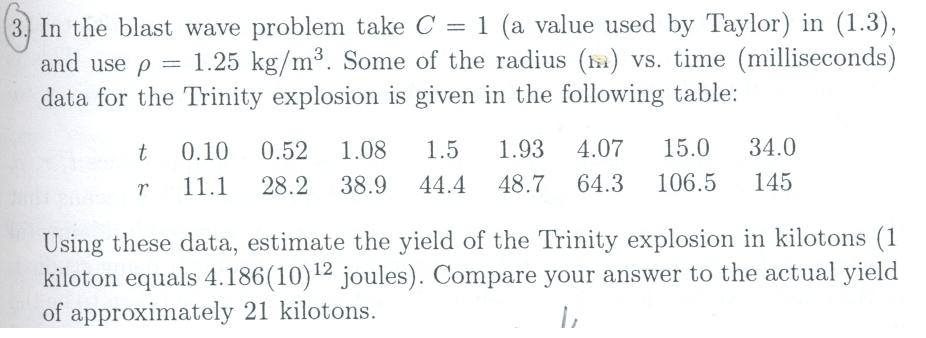
problem:
solution:
The blast equation is given by
Where \(r\) is radius of blast in meters, \(t\) is time since explosion in seconds, \(E\) energy of explosion in Joules, \(\rho \) is air density in Kg/m^3
We are given \(\rho =1.25\ kg/m^{3}\) and \(C=1\), hence the above can be rewritten as
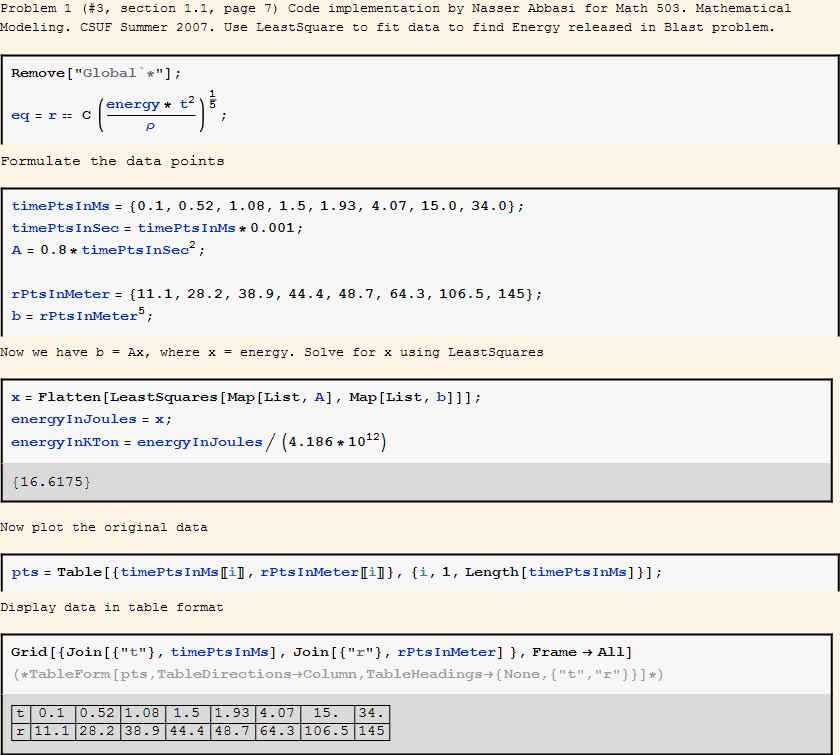
Let \(x=E,\) \(A=0.8t^{2}\), \(b=r^{5}\), then we have
And now \(x\) is found by least squares solution. Once \(x\) is found, then \(E\) is found since \(E=x\).
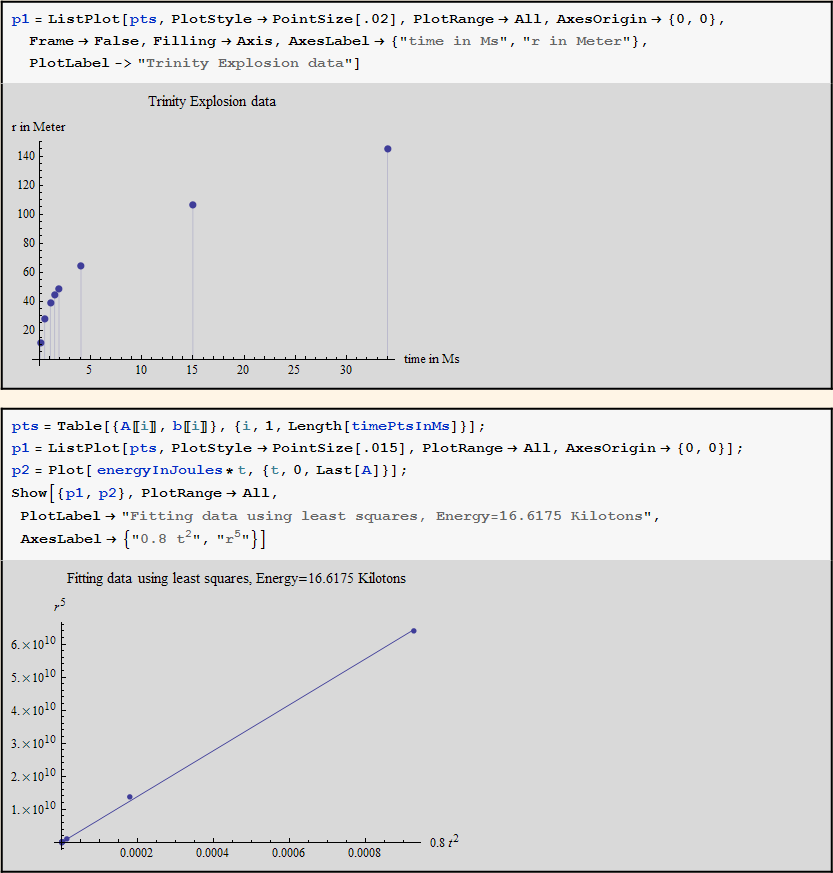
The code is shown on the next page. The least squares solutions shows that
problem:
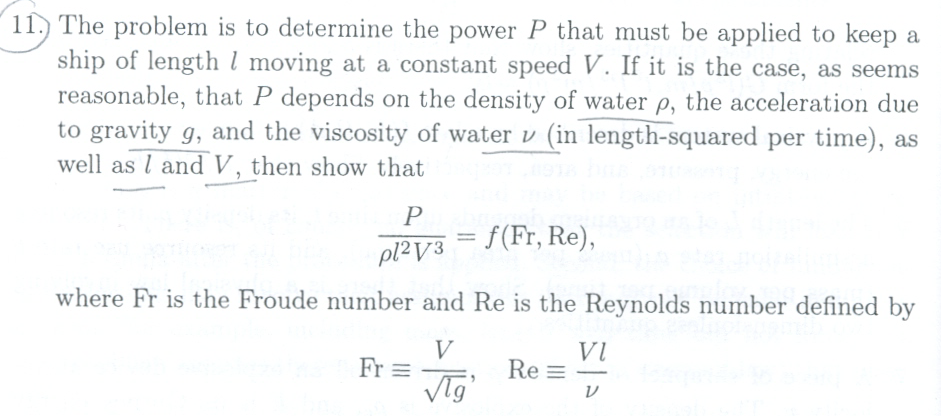
solution:
First make a list of all the physical variables and the corresponding dimensions.
| Variable | \(P\) (power) | \(_{l}\) (ship length) | \(V\) | \(\rho \) | \(\nu \) | \(g\) |
| meaning | work rate(F*d/t) | in meters | ship speed | water density | water Viscosity | gravity |
| Dimension | \(\frac {ML^{2}}{T^{3}}\) | \(L\) | \(\frac {L}{T}\) | \(\frac {M}{L^{3}}\) | \(\frac {L^{2}}{T}\) | \(\frac {L}{T^{2}}\) |
Hence we seek a physical law of the form
The function \(f\) is a combination of all the physical variables. Hence we write
For the above combination to be dimensionless, we must have each exponent term equal to zero. Hence we obtain the following 3 equations
Writing the above in matrix form
We see that the dimension matrix \(3\times 6\), hence its row space has dimension \(6\) and its column space has dimension \(3\). We need now to find the basis for the Null Space of the dimension matrix. Now reduce \(A\) to its reduce row echelon form
\(\begin {bmatrix} 1 & 0 & 0 & 1 & 0 & 0\\ 2 & 1 & 1 & -3 & 2 & 1\\ -3 & 0 & -1 & 0 & -1 & -2 \end {bmatrix} \overset {l_{21}=2}{\rightarrow }\begin {bmatrix} 1 & 0 & 0 & 1 & 0 & 0\\ 0 & 1 & 1 & -5 & 2 & 1\\ -3 & 0 & -1 & 0 & -1 & -2 \end {bmatrix} \overset {l_{31}=-3}{\rightarrow }\begin {bmatrix} 1 & 0 & 0 & 1 & 0 & 0\\ 0 & 1 & 1 & -5 & 2 & 1\\ 0 & 0 & -1 & 3 & -1 & -2 \end {bmatrix} \)
Now multiply last row by \(-1\rightarrow \begin {bmatrix} 1 & 0 & 0 & 1 & 0 & 0\\ 0 & 1 & 1 & -5 & 2 & 1\\ 0 & 0 & 1 & -3 & 1 & 2 \end {bmatrix} \), and now subtract last row from second row
\(\rightarrow \begin {bmatrix} 1 & 0 & 0 & 1 & 0 & 0\\ 0 & 1 & 0 & -2 & 1 & -1\\ 0 & 0 & 1 & -3 & 1 & 2 \end {bmatrix} \) and this is the final reduce row echelon form
we have rank=3 (the first 3 columns are Linearly independent). Therefor, we use the first 3 variables as the pivot variables, which are \(a,b,c\) and use as the free variables those which correspond to the last 3 columns, which are \(d,e,f\)
Now since
By back substitution, from the 3rd row we obtain \(c-3d+e+2f=0\), or \(c=3d-e-2f\) and from the second row we obtain \(b-2d+e-f=0\), or \(b=-e+f+2d\) , and from the first row we obtain \(a+d=0\) or \(a=-d\)
Hence the solution now can be written in terms of the free variables as
Therefor the basis for the null space of \(A\) are
Hence
Hence the complete set is
Hence the general solution is \(\pi =\pi _{1}^{\alpha }\pi _{2}^{\beta }\pi _{3}^{\gamma }\)
The Pi theorem says that there is a physical law expressed in terms of the dimensionless quantities called \(F\left ( \pi _{1},\pi _{2},\pi _{3}\right ) =0\) corresponding to the physical law \(f\left ( P,l,V,\rho ,\nu ,g\right ) =0\)
Now, we need to solve for \(P\), hence we write
Hence if we let \(g\left ( \frac {Vl}{\nu },\frac {V^{2}}{l\ g}\right ) =\pi _{2}\times \sqrt {\pi _{3}}\), then we see that
where
Let \(k\) be some constant, then the power needed is given by