problem:
Find all solutions to the heat equation \(u_{t}=\kappa u_{xx}\) of the form \(u\left ( x,t\right ) =U\left ( z\right ) \) where \(z=\frac {x}{\sqrt {\kappa t}}\)
answer:
We have that \(z\left ( x,t\right ) =\frac {x}{\sqrt {\kappa t}}\), hence \(\frac {\partial z}{\partial x}=\frac {1}{\sqrt {\kappa t}}\) and \(\frac {\partial ^{2}z}{\partial x^{2}}=0\) and \(\frac {\partial z}{\partial t}=-\frac {x}{2}\left ( \kappa t\right ) ^{-\frac {3}{2}}\kappa =\frac {-x}{2}\frac {t^{-\frac {3}{2}}}{\sqrt {k}}\)
Now
and
and
Plug in the above expressions into the PDE we obtain
But \(z=\frac {x}{\sqrt {\kappa t}}\), hence the above becomes
or
Let \(U^{^{\prime }}\left ( z\right ) =y\left ( z\right ) ,\) hence the above becomes
Integrate both sides
Hence
But since \(U^{^{\prime }}\left ( z\right ) =y\left ( z\right ) \), then
I think now I need to write the above in terms of \(x,t\) again. Fix time, and change \(x\) and so we have \(dz=\frac {\partial z}{\partial x}dx=\frac {1}{\sqrt {\kappa t}}dx\) and the above integral becomes
for any \(\xi \) location along the space dimension \(x\), where \(A\left ( \xi \right ) ,B\left ( \xi \right ) \) are functions that depend on the value \(\xi \)
problem:
Use the energy method to prove the uniqueness for the problem
Solution
First note that \(\nabla ^{2}u\equiv \frac {\partial ^{2}u}{\partial x_{1}^{2}}+\frac {\partial ^{2}u}{\partial x_{2}^{2}}+\cdots +\frac {\partial ^{2}u}{\partial x_{n}^{2}}\) i.e. the Laplacian.
Proof by contradiction. Assume there is no unique solution. Let \(u_{1}\left ( x,t\right ) \) and \(u_{2}\left ( x,t\right ) \) be 2 different solutions to the above PDE. Let \(w\left ( x,t\right ) \) be the difference between these 2 solutions. i.e. \(w\left ( x,t\right ) =u_{1}\left ( x,t\right ) -u_{2}\left ( x,t\right ) \), hence \(w\left ( x,t\right ) \) must satisfy the following conditions: it must be zero at the boundaries \(\mathbf {x}\in \partial \Omega \) for all time, and also it must be zero inside \(\Omega \) initially. Hence
Now if we can show that \(w\left ( \mathbf {x},t\right ) =0\) for \(t>0\) inside \(\Omega \), then this would imply that \(u_{1}\left ( x,t\right ) =u_{2}\left ( x,t\right ) \), showing a contradiction, hence completing the proof.
i.e. we need to show that \(w_{t}\left ( \mathbf {x},t\right ) =\nabla ^{2}w\left ( \mathbf {x},t\right ) \) yields a solution \(w\left ( \mathbf {x},t\right ) =0\) for \(\mathbf {x}\in \Omega ,t>0\)
Using the energy argument, we write
First we note that \(E\left ( 0\right ) =0\,\)since \(w\left ( \mathbf {x},0\right ) =0\) from the initial conditions above.
But \(\frac {\partial }{\partial t}w\left ( \mathbf {x},t\right ) =\nabla ^{2}w\left ( \mathbf {x},t\right ) \) from the PDE itself, hence the above becomes
But from Green first identity which states the following
Replace \(u\) by \(w\) in the above, we obtain
Comparing (1) and (2) we see that LHS of (2) is \(\frac {1}{2}E^{\prime }\left ( t\right ) \) Hence the above become
But \(\nabla w\cdot \nabla w=\left \Vert \nabla w\right \Vert ^{2}\), so the above becomes
But \(w\left ( \mathbf {x},t\right ) =0\) on \(\partial \Omega \) for \(t>0\), since this is the boundary conditions. Hence the above becomes
Therefore we showed that \(E^{\prime }\left ( t\right ) \) is \(\leq 0\) since \(\int _{\Omega }\left \Vert \nabla w\right \Vert ^{2}\ d\mathbf {x\geq 0}\)
So energy inside \(\Omega \) is nonincreasing with time. But since \(E\left ( 0\right ) =0\) then \(E\left ( t\right ) =0\) (since energy can not be negative, this is the only choice left).
Therefore, from \(E\left ( t\right ) =\int _{\Omega }w^{2}\left ( \mathbf {x},t\right ) d\mathbf {x}\), we conclude that \(w\left ( \mathbf {x},t\right ) =0\) everywhere in \(\Omega \) for \(t>0\) since \(w\left ( \mathbf {x},t\right ) \) is continuous in both its arguments.
Hence we conclude since \(w\left ( \mathbf {x},t\right ) =u_{1}\left ( \mathbf {x},t\right ) -u_{2}\left ( \mathbf {x},t\right ) =0\) then \(u_{1}\left ( \mathbf {x},t\right ) =u_{2}\left ( \mathbf {x},t\right ) \), then the PDE solution is unique.
problem:
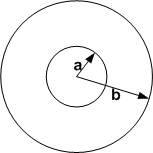
In absence of sources derive the diffusion equation for radial motion in the plane \(u_{t}=\frac {D}{r}\left ( ru_{r}\right ) _{r}\) from first principles. That is, take an arbitrary domain between circles \(r=a,r=b\) and apply conservation law for the density \(u=u\left ( r,t\right ) \) assuming the flux is \(J\left ( r,t\right ) =-Du_{r}\). Assume no sources.
Answer:
First note that the density \(u\left ( r,t\right ) \) is measured in quantity per unit volume.
Consider a cross sectional area through circle \(r_{a}=a\). This area is \(2\pi hr_{a}\) where \(h\) is the width of the strip.
Let \(J\left ( r,t\right ) \) be the flux at \(r\) at time \(t\) , measured in quantity per unit area per unit time.
Hence amount \(u\) that passes though cross sectional area at \(r_{a}\) , per unit time, is \(A\left ( r_{a}\right ) J\left ( r_{a},t\right ) \) where \(A\left ( r_{a}\right ) =2\pi hr_{a}\)
Similarly, amount \(u\) that passes though cross sectional area at \(r_{b}\) , per unit time, is \(A\left ( r_{b}\right ) J\left ( r_{a},t\right ) \) where \(A\left ( r_{b}\right ) =2\pi hr_{b}\)
Hence the net amount that flows, per unit time, between \(r_{b}\) and \(r_{a}\) is \(A\left ( r_{a}\right ) J\left ( r_{a},t\right ) -A\left ( r_{b}\right ) J\left ( r_{b},t\right ) \)
Since there is no source nor sink inside this region, then the above equal the rate at which the amount \(u\) itself changes between \(r_{b}\) and \(r_{a}\), which is \(\frac {d}{dt}\left ( u\left ( r,t\right ) \times \text {volume between }r_{a}\ \text {and }r_{b}\right ) \).
Hence we have
Apply fundamental theorem of calculus on the RHS above where \(J\left ( a,t\right ) -J\left ( b,t\right ) =\int _{b}^{a}J_{r}dr\) hence the above becomes
But \(A\left ( r\right ) =2\pi rh\) so the above becomes
Changing the limits on the integral in the RHS above to make it match the LHS, we obtain
Because the above holds for all intervals of integration and the functions involved are continuous, then we can remove the integrals and just write
Now assuming diffusion model for the flux, i.e. \(J\left ( r,t\right ) =-Du_{r}\left ( r,t\right ) \), then the above becomes
Hence