On stress measures in deformed solids
Abstract
Different known stress measures used in continuum mechanics during deformation analysis are derived and geometrically illustrated. The deformed solid body is subjected to rigid body rotation tensor \(\tilde {Q}\). Expressions formulated showing how the deformation geometrical tensors \(\tilde {U}\), \(\tilde {V}\) and \(\tilde {R}\) are transformed under this rigid body motion. Each stress measure is analyzed under this rigid rotation.
For each stress tensor, the appropriate strain tensor used in the material stress-strain constitutive relation is derived analytically. The famous paper by Professor Satya N. Atluri [2] was used as the main framework and guide for all these derivations.
Contents
1.1 Different stress tensors
1.2 Deformation gradient tensor under rigid body transformation Q
1.3 Stress tensors under rigid body transformation Q
1.4 Conjugate pairs (Stress tensor/Strain tensor)
2 Overview of geometry and mathematical notations used
2.1 Illustration of the polar decomposition of the deformation gradient tensor F
2.1.1 Polar decomposition applied to a vector
2.1.2 Polar decomposition applied to an oriented area
3 Stress Measures
3.1 Cauchy stress measure
3.2 First Piola-Kirchhoff or Piola-Lagrange stress measure
3.3 Second Piola-Kirchhoff stress tensor
3.4 Kirchhoff stress tensor
3.5 Gamma stress tensor
3.6 Biot-Lure stress tensor
3.7 Jaumann stress tensor r
3.8 The stress tensor T
3.9 The stress tensor T
4 Geometry and stress tensors transformation due to rigid body rotation
4.1 Deformation tensors transformation FU and V due to rigid body rotation Q
4.1.1 Transformation of F (the deformation gradient tensor)
4.1.2 Transformation of U (the stretch before rotation R tensor)
4.1.3 Transformation of V (The stretch after rotation R tensor)
4.2 Stress tensors transformation due to rigid body rotation Q
4.2.1 Transformation of stress tensor tau (Cauchy stress tensor)
4.2.2 Transformation of first Piola-Kirchhoff stress tensor
4.2.3 Transformation of second Piola-Kirchhoff stress tensor
4.2.4 Transformation of Kirchhoff stress tensor sigma
4.2.5 Transformation of Gamma stress tensor
4.2.6 Transformation of Biot-Lure stress tensor
4.2.7 Transformation of Juamann stress tensor
4.2.8 Transformation of T stress tensor
4.2.9 Transformation of T stress tensor
5 Constitutive Equations using conjugate pairs for nonlinear elastic materials with large deformations: Hyper-elasticity
5.1 Conjugate pair for Cauchy stress tensor
5.2 Conjugate pair for second Piola-kirchhoff stress tensor
5.3 Conjugate pair for first Piola-kirchhoff stress tensor
5.4 Conjugate pair for Kirchhoff stress tensor
5.5 Conjugate pair for Biot-Lure stress tensor
5.6 Conjugate pair for Jaumann stress tensor
6 Stress-Strain relations using conjugate pairs based on complementary strain energy
7 Appendix
7.1 Derivation of the deformation gradient tensor F in normal Cartesian coordinates system
7.2 Useful identities and formulas
8 References
.
1 Conclusion and results
1.1 Different stress tensors
| Stress | Stress measure | Generally Symmetrical ? |
| \(\mathbf {\tilde {\tau }}\) Cauchy | \(\mathbf {df}=\left ( da\ \mathbf {n}\right ) \cdot \mathbf {\tilde {\tau }}\) | Yes |
| \(\mathbf {\tilde {t}}\) First Piola-Kirchhoff | \(\mathbf {\tilde {t}}=J\ \mathbf {\tilde {F}}^{-1}\cdot \mathbf {\tilde {\tau }}\) | No |
| \(\mathbf {\tilde {s}}_{1}\)Second Piola-Kirchhoff | \(\mathbf {\tilde {s}}_{1}=J\ \mathbf {\tilde {F}}^{-1}\cdot \mathbf {\tilde {\tau }}\cdot \mathbf {\tilde {F}}^{-T}\) | Yes |
| \(\mathbf {\tilde {\sigma }}\) Kirchhoff | \(\mathbf {\tilde {\sigma }}=J\ \mathbf {\tilde {\tau }}\) | Yes |
| \(\boldsymbol {\tilde {\Gamma }}\) | \(\boldsymbol {\tilde {\Gamma }=\tilde {R}}^{T}\cdot \mathbf {\tilde {\tau }\cdot \tilde {R}}\) | Yes |
| \(\mathbf {\tilde {r}}^{\ast }\) Biot-Lure | \(\mathbf {\tilde {r}}^{\ast }=J\ \mathbf {\tilde {F}}^{-1}\mathbf {\cdot \tilde {\tau }}\cdot \mathbf {\tilde {R}}\) | No |
| \(\mathbf {\tilde {r}}\) Jaumann | \(\mathbf {\tilde {r}=}\frac {\left ( \mathbf {\tilde {r}}^{\ast }+\mathbf {\tilde {r}}^{\ast T}\right ) }{2}\) | Yes |
| \(\mathbf {\tilde {T}}^{\ast }\) | \(J\ \mathbf {\tilde {V}}^{-1}\mathbf {\cdot \ \tilde {\tau }}\) | No |
| \(\mathbf {\tilde {T}}\) | \(\mathbf {\tilde {T}=}\frac {\left ( \mathbf {\tilde {T}}^{\ast }+\mathbf {\tilde {T}}^{\ast T}\right ) }{2}\) | Yes |
1.2 Deformation gradient tensor under rigid body transformation \(\tilde {Q}\)
| Tensor | \(\mathbf {\tilde {Q}}\) based transformation |
| \(\mathbf {\tilde {F}}\) The deformation gradient | \(\mathbf {\tilde {F}}_{q}=\mathbf {\tilde {Q}\cdot \tilde {F}}\) |
| \(\mathbf {\tilde {U}~}\)Stretch before rotation \(\mathbf {\tilde {R}}\) | \(\mathbf {\tilde {U}}_{q}=\mathbf {\tilde {U}}\) |
| \(\mathbf {\tilde {V}~}\)Stretch after rotation \(\mathbf {\tilde {R}}\) | \(\mathbf {\tilde {V}}_{q}=\mathbf {\tilde {Q}\cdot \tilde {V}\cdot \tilde {Q}}^{T}\) |
1.3 Stress tensors under rigid body transformation \(\tilde {Q}\)
| Stress | \(\mathbf {\tilde {Q}}\) based transformation | Transforms Similar to |
| \(\mathbf {\tilde {\tau }}\) Cauchy | \(\mathbf {\tilde {\tau }}_{q}=\mathbf {\tilde {Q}\cdot \tilde {\tau }\cdot \tilde {Q}}^{T}\) | \(\mathbf {\tilde {V}}\) |
| \(\mathbf {\tilde {t}}\) First Piola-Kirchhoff | \(\mathbf {\tilde {t}}_{q}=\mathbf {\tilde {Q}}\cdot \mathbf {\tilde {t}}\) | \(\mathbf {\tilde {F}}\) |
| \(\mathbf {\tilde {s}}_{1}\)Second Piola-Kirchhoff | \(\mathbf {\tilde {s}}_{1_{q}}=\mathbf {\tilde {s}}_{1}\) | \(\mathbf {\tilde {U}}\) |
| \(\mathbf {\tilde {\sigma }}\) Kirchhoff | \(\mathbf {\tilde {\sigma }}=J\ \left ( \mathbf {\tilde {Q}\cdot \tilde {\tau }\cdot \tilde {Q}}^{T}\right ) \) | \(\mathbf {\tilde {V}}\) |
| \(\boldsymbol {\tilde {\Gamma }}\) | \(\boldsymbol {\tilde {\Gamma }}_{q}=\boldsymbol {\tilde {\Gamma }}\) | \(\mathbf {\tilde {U}}\) |
| \(\mathbf {\tilde {r}}^{\ast }\) Biot-Lure | \(\mathbf {\tilde {r}}_{q}^{\ast }=\mathbf {\tilde {r}}^{\ast }\) | \(\mathbf {\tilde {U}}\) |
| \(\mathbf {\tilde {r}}\) Jaumann | \(\mathbf {\tilde {r}}_{q}\mathbf {=\tilde {r}}\) | \(\mathbf {\tilde {U}}\) |
| \(\mathbf {\tilde {T}}^{\ast }\) | \(\mathbf {\tilde {T}}_{q}^{\ast }=\mathbf {\tilde {T}}^{\ast }\) | \(\mathbf {\tilde {U}}\) |
| \(\mathbf {\tilde {T}}\) | \(\mathbf {\tilde {T}}_{q}=\mathbf {\tilde {T}}\) | \(\mathbf {\tilde {U}}\) |
1.4 Conjugate pairs (Stress tensor/Strain tensor)
Let \(W\) be the current amount of energy stored in a unit volume as a result of the body undergoing deformation, then the time rate at which this energy changes will equal the stress tensor \(\mathbf {\tilde {B}}\) multiplied by the strain rate \(\frac {\partial \mathbf {\tilde {A}}}{\partial t}\). Therefore
The following table gives the stress tensor \(\mathbf {\tilde {B}}\), the strain rate \(\frac {\partial \mathbf {\tilde {A}}}{\partial t}\) and the strain \(\mathbf {\tilde {A}}\)
| Stress tensor \(\mathbf {\tilde {B}}\) | Strain tensor rate \(\frac {\partial \mathbf {\tilde {A}}}{\partial t}\) | Strain tensor \(\mathbf {\tilde {A}}\) |
| \(\mathbf {\tilde {\tau }}\) Cauchy | \(\frac {1}{J}\frac {1}{2}\left ( \mathbf {\dot {F}\cdot \tilde {F}}^{-1}+\left ( \mathbf {\dot {F}\cdot \tilde {F}}^{-1}\right ) ^{T}\right ) \) | Almansi strain tensor \(\mathbf {\tilde {\mu }}=\frac {1}{J} \frac {1}{2}\left ( \mathbf {\tilde {F}}^{-T}\cdot \mathbf {\tilde {F}} ^{-1}-\mathbf {\tilde {I}}\right ) \) |
| \(\mathbf {\tilde {\sigma }}\) Kirchhoff | \(\frac {1}{2}\left ( \mathbf {\dot {F} \cdot \tilde {F}}^{-1}+\left ( \mathbf {\dot {F}\cdot \tilde {F}}^{-1}\right ) ^{T}\right ) \) | \(\frac {1}{2}\left ( \mathbf {\tilde {F}}^{-T}\cdot \mathbf {\tilde {F}}^{-1}-\mathbf {\tilde {I}}\right ) \) |
| \(\mathbf {\tilde {t}\ }1^{st}\) Piola-Kirchhoff | \(\frac {1}{J}\mathbf {\dot {F} }^{T}\) | \(\frac {1}{J}\mathbf {\tilde {F}}^{T}\) |
| \(\mathbf {\tilde {s}}_{1}\) \(2^{nd}\) Piola-Kirchhoff | \(\frac {1}{J} \mathbf {\dot {\gamma }}\) | Green-Lagrange strain tensor \(\frac {1}{J} \boldsymbol {\tilde {\Gamma }=}\frac {1}{2J}\left ( \mathbf {\mathbf {\tilde {F}} ^{T}\cdot \tilde {F}-\tilde {I}}\right ) \) |
| \(\mathbf {\tilde {r}}^{\ast }\) Biot-Lure | \(\frac {1}{J}\mathbf {\dot {U}}\) | \(\frac {1}{J}\mathbf {\mathbf {U}}\) |
| \(\mathbf {\tilde {r}}\) Jaumann | \(\mathbf {\dot {U}}\) | \(\mathbf {\tilde {U}} \) |
| \(\boldsymbol {\tilde {\Gamma }}\) | \(\frac {1}{2}\left ( \mathbf {\tilde {U}}^{-1} \cdot \mathbf {\dot {U}+\dot {U}\cdot \tilde {U}}^{-1}\right ) \) | \(\ln \left ( \mathbf {\tilde {U}}\right ) \) (For isotropic material only) |
| \(\mathbf {\tilde {T}}\) | \(\mathbf {\dot {V}}\) (for isotropic only) | \(\mathbf {\tilde {V}}\) (For isotropic material only) |
2 Overview of geometry and mathematical notations used
Position and deformation measurements are of central importance in continuum mechanics. Two methods are employed : The Lagrangian method and the Eulerian method.
In the Lagrangian method, the particle position and speed are measured in reference to a fixed stationary observer based coordinates systems. This is called the referential coordinates system where the observer is located. Hence in the Lagrangian method, the particle state is measured from a global fixed frame of reference.
In Eulerian methods,a frame of reference is attached locally to the area of interest where the measurement is to be made, and the particle state is measured relative to the local coordinates systems (also called the body coordinates system). In continuum mechanics the Lagrangian method is used and in fluid mechanics the Eulerian method is used, but it is also possible to attach a local frame of reference to the body itself and then convert these measurements back relative to the global frame of reference.
A coordinate transformation gives back the coordinates of a point on a body relative to the global fixed reference frame, given the coordinates of the same point as measured in the local reference frame. This transformation is given by
The following diagram illustrates these differences.
In general, the interest is in finding differential changes that occur when a body deformed. This mean measuring how a differential vector that represents the orientation of one point relative to another changes as a body deformed.
Considering the Lagrangian method from now on. Attention is now shifted to what happens when the body starts to deform. The global reference frame is selected, this is where all measurements are made with reference to.
Measurements made when the body is undeformed is distinguished from those measurements made when the body has deformed. Upper case \(X_{i}\) is used for the coordinates of a point on the body when the body is undeformed, and lower case \(x_{i}\) is used for the coordinates of the same point when measured in reference to this same global coordinate system but after the body has deformed.
Diagram below takes a snap shot of the system after 5 units of time and measures the deformation to illustrate the notation used.
Another way to represent the above is by using the same diagram to show both the undeformed and the deformed configuration as follows.
Let \(B\) be the undeformed configuration, referred to as the body \(state\). By state it is meant the set of independent variables needed to fully describe the forces and geometry of the body.
When the body is in the undeformed state \(B\), it is assumed to be free of internal stresses and that no traction forces act on it.
External loads are now applied to the body resulting in a change of state. The new state can be a result of only a deformation in the body shape, or due to only a rigid body translation/rotation, or it could be a result of a combination of deformation and rigid body motion.
The deformation will take sometime \(t\) to complete. However, in this discussion the interest is only in the final deformed state, which is called state \(b\). Hence no function(s) of time will be appear or be involved in this analysis.
The boundary conditions is assumed to be the same in state \(B\) and in state \(b\). This implied that if the solid body was in physical contact with some external non-moving supporting configuration, then after the deformation is completed, the body will remain in the same physical contact with these supports and at the same points of contact as before the deformation began.
This implies the body is free to deform everywhere, except that it is constrained to deform at those specific points it is in contact with the support. For the rigid body rotation, it is assumed the body with its support will rotate together.
A very important operator in continuum mechanics is the deformation tensor \(\mathbf {\tilde {F}}\). (A tensor can be viewed as an operator which takes a vector and maps it to another vector). This tensor allows the determination of the deformed differential vector \(dr\) knowing the undeformed differential vector \(dR\) as follows.
The tensor \(\mathbf {\tilde {F}}\) is a field tensor in general, which mean the actual value of the tensor changes depending on the location of the body where the tensor is evaluated. Hence it is a function of the body coordinates. Reference [4] gives simple examples showing how to calculate \(\mathbf {\tilde {F}}\) for simple cases of deformations in 2D. The appendix contains derivation of \(\mathbf {\tilde {F}}\) in the specific case of normal Cartesian coordinates.
2.1 Illustration of the polar decomposition of the deformation gradient tensor \(\tilde {F}\)
2.1.1 Polar decomposition applied to a vector
The effect of applying the deformation gradient tensor \(\mathbf {\tilde {F}}\) on a vector \(\mathbf {dR}\) can be considered to have the same result as the effect of first applying a stretch deforming tensor \(\mathbf {\tilde {U}}\) (Also called the deformation tensor) on \(\mathbf {dR}\), resulting in a vector \(\mathbf {dR}^{\ast }\), followed by applying a rotation deforming tensor \(\mathbf {\tilde {R}}\) on this new vector \(\mathbf {dR}^{\ast }\) to produce the final vector \(\mathbf {dr.}\)
Hence \(\mathbf {\tilde {F}}=\mathbf {\tilde {U}}\cdot \mathbf {\tilde {R}}\) and therefore
Using polar decomposition gives
This is called polar decomposition of \(\mathbf {\tilde {F}}\), and it is always possible to find such decomposition. In addition, this decomposition is unique for each tensor \(\mathbf {\tilde {F}}\).
2.1.2 Polar decomposition applied to an oriented area
An oriented area in the undeformed state is \(dA\ \mathbf {N}\) (Where \(\mathbf {N}\) is a unit normal to \(dA\)). This area becomes \(da\ \mathbf {n}^{\ast }\) after the application of the stretch tensor \(\mathbf {\tilde {U}}\). It is clear that rotation will not have an effect on the area \(da\) itself, but it will rotate the unit vector \(\mathbf {n}^{\ast }\) which is normal to \(da\) to become the unit vector \(\mathbf {n}\). This is illustrated in the diagram below.
Now that a brief description of the geometry and the important tensor \(\mathbf {\tilde {F}}\) is given above, discussion of the main topic of this paper will start.
3 Stress Measures
Before outlining the different stress measures, the different entities involved are described and illustrated.
Given the undeformed state \(B\), let \(P\) a point in \(B\) where its location in the deformed state becomes \(b\) (Lagrangian description). Let \(dA\) be a differential area at point \(P\) on the surface of \(B\) where \(\mathbf {dN}\) is a unit vector normal to this area in \(B\). After deformation, this differential area will is deformed to a new differential area \(da\) in the deformed state \(b\). Let \(\mathbf {dn}\) be the unit vector normal to \(da\) in \(b\).
Let \(\mathbf {df}\) be the differential force vector which represents the resultant of the total internal forces acting on \(da\) in the deformed state \(b\).
The following diagram illustrates the above.
3.1 Cauchy stress measure
The Cauchy stress measure \(\mathbf {\tilde {\tau }}\) is a measure of
It is called the true measure of stress. The followng follows from the above definition
Cauchy stress tensor is in general (in absence of body couples) a symmetric tensor.
3.2 First Piola-Kirchhoff or Piola-Lagrange stress measure
The above diagram shows that this stress \(\mathbf {\tilde {t}}\) can be regarded as
.
The following shows the derivation of this stress tensor. Starting by moving the vector \(\mathbf {df}\) (the result of internal forces in the deformed state) which acts on the deformed area \(da\) in a parallel transport to the image of \(da\) in the undeformed state, which will be the differential area \(dA\)
Hence in the undeformed state the following results
Given that
Which is a relationship derived from geometrical consideration [2], then from the above equation the following results
Since \(\mathbf {df}=\left ( da\ \mathbf {n}\right ) \cdot \tilde {\tau }\), then using the above equation gives
Comparing (1) to (2) gives
3.3 Second Piola-Kirchhoff stress tensor
From the above diagram stress \(\tilde {s}_{1}\) can be regarded as
.
The stress measure \(\tilde {s}_{1}\) is similar to the first Piola-Kirchhoff stress measure, except that instead of parallel transporting the force \(\mathbf {df}\) from the deformed state to the undeformed state, a force vector \(\mathbf {d\hat {f}}\) is first created which is derived from \(\mathbf {df}\) and then parallel transport this new vector is made.
Everything else remains the same. The purpose of this is that the second Piola-Kirchhoff stress tensor will now be a symmetric tensor while the first Piola-Kirchhoff stress tensor was nonsymmetric.
Hence in the undeformed state (after parallel transporting \(\mathbf {d\hat {f}}\) to \(dA\)) the following relationship results
In the deformed state the following relation applies
As before, an expression for \(\mathbf {\tilde {s}}_{1}\) in terms of the Cauchy stress tensor \(\tilde {\tau }\) is now found.
Given that
Substituting the above in (3) gives
From (1) \(\mathbf {df}=\mathbf {\tilde {F}}^{T}\cdot \mathbf {d\hat {f}}\) , hence the above equation becomes
Therefore
Comparing (4) with (2) gives
Therefore the second Piola-Kirchhoff stress tensor is
The second Piola-Kirchhoff stress tensor is in general symmetric.
3.4 Kirchhoff stress tensor
Kirchhoff stress tensor \(\mathbf {\tilde {\sigma }}\) is a scalar multiple of the true stress tensor \(\mathbf {\tilde {\tau }}\). The scale factor is the determinant of \(\mathbf {\tilde {F}}\), the deformation gradient tensor.
Hence
\(\mathbf {\tilde {\sigma }}\) is symmetric when \(\mathbf {\tilde {\tau }}\) is symmetric which is in general the case.
3.5 \(\tilde {\Gamma }\) stress tensor
The \(\boldsymbol {\tilde {\Gamma }}\) stress tensor is a result of internal forces generated due to the application of the stretch tensor only. Hence this stress acts on the area deformed due to stretch only. Therefore this stress represents
.
Assuming these are called \(\mathbf {df}^{\ast }\), then applying this definition results in
When in the final deformed state the following relation applies before
The above means that the stretched state can be considered as a partial deformed state, and the final deformed state as the result of applying the rotation tensor on the stretched state. In the final deformed state the result of the internal forces is \(\mathbf {df}\) while in the stretched state, in which all the variables in that state are designated with a star *, the internal forces are called \(\mathbf {df}^{\ast }\)
Therefore
Equation (3) can be written as \(\mathbf {df}^{\ast }=\mathbf {df\cdot \tilde {R}}\). Substituting this into (1) gives
Substituting for \(\mathbf {df}\) in the above equation the expression for \(\mathbf {df}\) in (2) results in
But \(da\ \mathbf {n=\tilde {R}}\cdot \left ( da\ \mathbf {n}^{\ast }\right )\) hence the above equation becomes
Therefore
3.6 Biot-Lure \(\tilde {r}^{\ast }\) stress tensor
This stress measure exists in the undeformed state as a result of parallel translation of the \(\mathbf {df}^{\ast }\) forces generated in the stretched state back to the undeformed state and applying this force into the image of the stretched area in the undeformed state. Therefore this stress can be considered as
In a sense, it is one step more involved than the \(\boldsymbol {\tilde {\Gamma }}\) stress tensor described earlier. The following diagram illustrates the above.
From the above diagram an expression for the Biot-Lure stress tensor is now given
Now an expression for \(\mathbf {\tilde {r}}^{\ast }\) is found. Since \(\mathbf {df}^{\ast }=\mathbf {df}\cdot \mathbf {\tilde {R}}\), the above equation becomes
Given that \(\mathbf {df}=da\ \mathbf {n\cdot \tilde {\tau }}\), the above equation becomes
But \(da\ \mathbf {n}=J\ \left ( dA\ \mathbf {N}\right ) \cdot \mathbf {\tilde {F}}^{-1}\) hence the above equation becomes
By comparison it follows that
The stress tensor \(\mathbf {\tilde {r}}^{\ast }\) is un-symmetric when \(\mathbf {\tilde {\tau }}\) is symmetric which is in the general is the case.
3.7 Jaumann stress tensor \(\tilde {r}\)
This stress tensor is introduced to create a symmetric stress tensor from the Biot-Lure stress tensor as follows
3.8 The stress tensor \(\tilde {T}^{\ast }\)
This stress tensor is defined in the rotated state without any stretch being applied before. The forces that act on the rotated area were parallel transported from the forces that were generated in the final deformed state. Hence this stress can be considered as
The following diagram illustrates this. Since rotation have been applied before stretch, then the polar decomposition of \(\mathbf {\tilde {F}}\) becomes
Where \(\mathbf {\tilde {V}}\) is the rotation tensor (which was called \(\mathbf {\tilde {R}}\) when it was applied after stretch), and \(\mathbf {\tilde {U}}\) is the stretch tensor.
The above diagram shows that
Since \(\mathbf {df}=da\ \mathbf {n\cdot \tilde {\tau }}\), the above equation becomes
But \(da\ \mathbf {n}=J\left ( dA\ \mathbf {N}^{\ast }\cdot \mathbf {\tilde {V}}^{-1}\right ) \) hence the above equation becomes
Therefore
\(\mathbf {\tilde {T}}^{\ast }\) is un-symmetric when \(\mathbf {\tilde {\tau }}\) is symmetric.
3.9 The stress tensor \(\tilde {T}\)
This stress tensor is introduced to create a symmetric stress tensor from the \(\mathbf {\tilde {T}}^{\ast }\) stress tensor as follows
No physical interpretation of this stress tensor can be made similar to the \(\mathbf {\tilde {T}}^{\ast }\) stress tensor.
4 Geometry and stress tensors transformation due to rigid body rotation
Now consideration is given to changes of the geometrical deforming tensors \(\mathbf {\tilde {F},\tilde {U}}\) and \(\mathbf {\tilde {V}}\) when the body is in its final deformed state and then subjected to a pure rigid body rotation \(\mathbf {\tilde {Q}}\), and to what happens to the various stress tensors derived above under the same \(\mathbf {\tilde {Q}}\).
Polar decomposition of \(\mathbf {\tilde {F}}\) is given by
The effect of applying pure rigid body rotation \(\mathbf {\tilde {Q}}\) on \(\mathbf {\tilde {F},\tilde {U}}\) and \(\mathbf {\tilde {V} }\) is now determined.
In each of the following derivations the following setting is assumed to be in place: There is a body originally in the undeformed state \(B\) and loads are applied on the body. The body undergoes deformation governed by the deformation gradient tensor \(\mathbf {\tilde {F}}\) resulting in the body being in the final deformed state state \(b\) with a stress tensor \(\mathbf {\tilde {\tau }}\) at point \(p\). If the body is considered to be first under the effect of \(\mathbf {\tilde {U}}\) (stretch), then the new state will be called \(B^{\ast }\), and after applying the effect of \(\mathbf {\tilde {R}}\) (point to point rotation tensor), then the state will be called \(b\) (which is the final deformation state).
If however \(\mathbf {\tilde {R}}\) (rotation) is applied first, then the new state will also be called \(B^{\ast }\) and then when applying the stretch \(\mathbf {\tilde {V}}\) the state will becomes \(b\) (which is the final deformation state).
From state \(b\), which is the final deformation state, a pure rigid body rotation tensor \(\mathbf {\tilde {Q}}\) is applied to the whole body (with its fixed supports if any). Hence there will be no changes in the body shape, and the new state is called \(q\).
Is also possible to consider the change of state from state \(B\) to state \(q\) to be the result of a new deformation gradient tensor which is called \(\mathbf {\tilde {F}}_{q}\). The polar decomposition of \(\mathbf {\tilde {F}}_{q}\) can also be written as
\(\mathbf {\tilde {F}}\) is compared to \(\mathbf {\tilde {F}}_{q}\), and \(\mathbf {\tilde {U}}\) is compared to \(\mathbf {\tilde {U}}_{q}\) and \(\mathbf {\tilde {V}}\) is compared to \(\mathbf {\tilde {V}}_{q}\) in order to see the effect of the rigid body rotation on these tensors.
4.1 Deformation tensors transformation (\(\tilde {F},\tilde {U}\) and \(\tilde {V}\)) due to rigid body rotation \(\tilde {Q}\)
4.1.1 Transformation of \(\tilde {F}\) (the deformation gradient tensor)
The above diagram show that
4.1.2 Transformation of \(\tilde {U}\) (the stretch before rotation \(\tilde {R}\) tensor)
Given that
Similarly,
Where \(\mathbf {\tilde {F}}_{q}\) \(=\mathbf {\tilde {Q}\cdot \tilde {F}}\), hence the above becomes
Using linear algebra it follows that \(\left ( \mathbf {\tilde {Q}\cdot \tilde {F}}\right ) ^{T}=\mathbf {\tilde {F}}^{T}\cdot \mathbf {\tilde {Q}}^{T}\). Therefore the above becomes
But \(\mathbf {\tilde {Q}}^{T}\mathbf {\cdot \tilde {Q}=\tilde {I}}\) since \(\mathbf {\tilde {Q}}\) is orthogonal. Hence the above becomes
.
4.1.3 Transformation of \(\tilde {V}\) (The stretch after rotation \(\tilde {R}\) tensor)
Since
And \(\mathbf {\tilde {F}=\tilde {R}}\cdot \mathbf {\tilde {U}}\) by polar decomposition on \(\mathbf {\tilde {F}}\) the above can be written as
Applying polar decomposition on \(\mathbf {\tilde {F}}_{q}\) results in \(\mathbf {\tilde {F}}_{q}=\mathbf {\tilde {R}}_{q}\cdot \mathbf {\tilde {U}}_{q}\) and the above becomes
It was found earlier that \(\mathbf {\tilde {U}}_{q}=\mathbf {\tilde {U}}\), therefore the above becomes
Now the second form of polar decomposition on \(\mathbf {\tilde {F}}_{q}\) is utilized giving
Substituting (2) into the above equation results in
Substituting (1) into the above gives
Since \(\mathbf {\tilde {Q}\cdot \tilde {R}}\) is invertible (need to check), the above can be written as
But \(\left ( \mathbf {\tilde {Q}\cdot \tilde {R}}\right ) ^{-1}=\mathbf {\tilde {R}}^{T}\mathbf {\cdot \tilde {Q}}^{T}\) (Since \(\mathbf {\tilde {Q}\cdot \tilde {R}}\) is an orthogonal matrix. (check). Hence the above becomes
From polar decomposition it is known that \(\mathbf {\tilde {F}=\tilde {V}\cdot \tilde {R}}\), hence \(\mathbf {\tilde {V}=\tilde {F}\cdot \tilde {R}}^{-1}\), but \(\mathbf {\tilde {R}}^{-1}=\mathbf {\tilde {R}}^{T}\) since it is an orthogonal matrix, therefore
Substituting (4) in (3) gives
This above is how \(\mathbf {\tilde {V}}\) transforms due to rigid rotation \(\mathbf {\tilde {Q}}\).
Now that the transformation of \(\mathbf {\tilde {F},\tilde {U}}\) and \(\mathbf {\tilde {V}}\) was obtained, the next step is to find how each one of the stress tensors derived earlier transforms due to \(\mathbf {\tilde {Q}}\).
4.2 Stress tensors transformation due to rigid body rotation \(\tilde {Q}\)
4.2.1 Transformation of stress tensor \(\tilde {\tau }\) (Cauchy stress tensor)
The stress \(\mathbf {\tilde {\tau }}_{q}\) (Cauchy stress in state \(q\)) is calculated at the point \(b_{q}\). Since this is a rigid body rotation, the area \(da\) will not change, only the unit normal vector \(\mathbf {n}\) will change to \(\mathbf {n}_{q}\)
The tensor \(\mathbf {\tilde {Q}}\) maps the vector \(\mathbf {df}\) to the vector \(\mathbf {df}_{q}\)
Exchanging the order of \(\mathbf {\tilde {\tau }}\) and \(da\ \mathbf {n}\) and using the transpose of \(\mathbf {\tilde {\tau }}\) gives
Therefore since the tensor \(\mathbf {\tilde {Q}}\) maps the oriented area \(\left ( da\ \mathbf {n}\right ) \) to the oriented area \(\left ( da\ \mathbf {n}_{q}\right ) \) then
Or
Substituting (4) into (3) gives
However, the stress \(\mathbf {\tilde {\tau }}_{q}\) in state \(q\) is given by \(\mathbf {df}_{q}=\left ( da\ \mathbf {n}_{q}\right ) \cdot \mathbf {\tilde {\tau }}_{q}\), hence the above equation becomes
Or
This implies
Comparing the above transformation result with the deformation tensors transformation results in
4.2.2 Transformation of first Piola-Kirchhoff stress tensor
The transformation of the first Piola-Kirchhoff stress tensor \(\mathbf {\tilde {t}}\) is given below.
Earlier it was shown that
Which implies
However, it was found earlier that \(\mathbf {\tilde {\tau }}_{q}=\mathbf {\tilde {Q}\cdot \tilde {\tau }}\cdot \mathbf {\tilde {Q}}^{T}\) therefore the above becomes
Now an expression for \(\mathbf {\tilde {F}}_{q}^{-1}\) is found.
Since \(\mathbf {\tilde {F}}_{q}=\mathbf {\tilde {Q}\cdot \tilde {F}}\), then \(\mathbf {\tilde {F}}_{q}^{-1}=\left ( \mathbf {\tilde {Q}\cdot \tilde {F}}\right ) ^{-1}\), hence \(\mathbf {\tilde {F}}_{q}^{-1}=\mathbf {\tilde {F}}^{-1}\cdot \mathbf {\tilde {Q}}^{-1}\). But since \(\mathbf {\tilde {Q}}\) is orthogonal, then \(\mathbf {\tilde {Q}}^{-1}=\mathbf {\tilde {Q}}^{T}\), therefore
However, since \(\mathbf {\tilde {t}}=J\mathbf {\tilde {F}}^{-1}\mathbf {\cdot \tilde {\tau }}\) the above simplifies to
\(\displaystyle \mathbf {\tilde {t}} \text {transforms similarly to} \mathbf {\tilde {F}} \)
4.2.3 Transformation of second Piola-Kirchhoff stress tensor
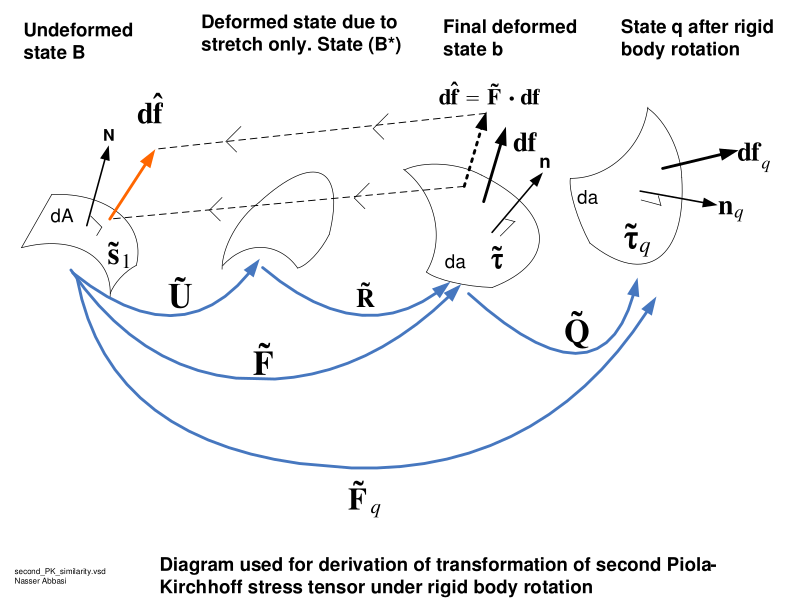
The transformation of the second Piola-Kirchhoff stress tensor \(\mathbf {\tilde {s}}_{1}\) is given below.
From earlier
Hence
An expression for \(\mathbf {\tilde {F}}_{q}^{-1}\) is now found. Since \(\mathbf {\tilde {F}}_{q}=\mathbf {\tilde {Q}\cdot \tilde {F}}\), hence \(\mathbf {\tilde {F}}_{q}^{-1}=\left ( \mathbf {\tilde {Q}\cdot \tilde {F}}\right ) ^{-1}\), hence \(\mathbf {\tilde {F}}_{q}^{-1}=\mathbf {\tilde {F}}^{-1}\cdot \mathbf {\tilde {Q}}^{-1}\). But since \(\mathbf {\tilde {Q}}\) is orthogonal, then \(\mathbf {\tilde {Q}}^{-1}=\mathbf {\tilde {Q}}^{T}\), hence
The above equation becomes
\(\mathbf {\tilde {F}}_{q}^{-T}=\left ( \mathbf {\tilde {F}}_{q}^{-1}\right ) ^{T}\) hence \(\mathbf {\tilde {F}}_{q}^{-T}=\left ( \mathbf {\tilde {F}}^{-1}\cdot \mathbf {\tilde {Q}}^{T}\right ) ^{T}\), therefore
The above equation becomes
From earlier it was found that \(\mathbf {\tilde {\tau }}_{q}=\mathbf {\tilde {Q}\cdot \tilde {\tau }\cdot \tilde {Q}}^{T}\) Therefore the above equation becomes
Therefore
This is the same as \(\mathbf {\tilde {s}}_{1}\), hence
Since it was found earlier that \(\mathbf {\tilde {U}}_{q}=\mathbf {\tilde {U}}\) therefore
4.2.4 Transformation of Kirchhoff stress tensor \(\tilde {\sigma }\)
Since \(\mathbf {\tilde {\sigma }}\) is a scalar multiple of \(\mathbf {\tilde {\tau }}\) and from earlier it was found that \(\mathbf {\tilde {\tau }}\) is a conjugate pair with \(\mathbf {\tilde {V}}\) then it is concluded that
4.2.5 Transformation of \(\tilde {\Gamma }\) stress tensor
The transformation of the second \(\boldsymbol {\tilde {\Gamma }}\) stress tensor is shown below.
From earlier it is shown that
But \(\mathbf {\tilde {F}}_{q}=\mathbf {\tilde {Q}}\cdot \mathbf {\tilde {F}}\) and using polar decomposition results in
But \(\mathbf {\tilde {F}}=\mathbf {\tilde {R}}\cdot \mathbf {\tilde {U}}\ \) hence \(\mathbf {\tilde {F}}^{-1}=\left (\mathbf {\tilde {R}}\cdot \mathbf {\tilde {U}}\right )^{-1}=\mathbf {\tilde {U}}^{-1}\cdot \mathbf {\tilde {R}}^{-1}\), and the above becomes
But \(\mathbf {\tilde {R}}^{-1}=\mathbf {\tilde {R}}^{T}\) therefore
Hence
Substituting (2) and (3) into (1) gives
Since \(\mathbf {\tilde {R}}\) and \(\mathbf {\tilde {R}}_{q}^{T}\) are orthogonal, the above reduces to
4.2.6 Transformation of Biot-Lure stress tensor \(\tilde {r}^{\ast }\)
The transformation of the Biot-Lure stress tensor \(\mathbf {\tilde {r}}^{\ast }\) is given below.
From earlier
Hence
But \(\mathbf {\tilde {\tau }}_{q}=\mathbf {\tilde {Q}\cdot \tilde {\tau }\cdot \tilde {Q}}^{T}\) therefore
Since \(\mathbf {\tilde {F}}_{q}=\mathbf {\tilde {Q}\cdot \tilde {F}}\) then \(\mathbf {\tilde {F}}_{q}^{-1}=\left ( \mathbf {\tilde {Q}\cdot \tilde {F}}\right ) ^{-1}=\mathbf {\tilde {F}}^{-1}\cdot \mathbf {\tilde {Q}}^{-1}\) but \(\mathbf {\tilde {Q}}\) is orthogonal, hence \(\mathbf {\tilde {Q}}^{-1}=\mathbf {\tilde {Q}}^{T}\), hence \(\mathbf {\tilde {F}}_{q}^{-1}=\mathbf {\tilde {F}}^{-1}\cdot \mathbf {\tilde {Q}}^{T}\). Therefore (2) can be written as
Since \(\mathbf {\tilde {F}}_{q}=\mathbf {\tilde {Q}\cdot \tilde {F}}\) and by polar decomposition \(\mathbf {\tilde {F}}_{q}=\mathbf {\tilde {R}}_{q}\mathbf {\cdot \tilde {U}}_{q}\) then
Substituting (4) into (3) gives
Since \(\mathbf {\tilde {F}=\tilde {R}\cdot \tilde {U}}\) the above becomes
From earlier \(\mathbf {\tilde {U}=\tilde {U}}_{q}\), therefore the above becomes
From (1) gives
4.2.7 Transformation of Juamann stress tensor \(\tilde {r}\)
The transformation of the Juamann stress tensor \(\mathbf {\tilde {r}}\) is shown below.
From earlier
Therefore
Since \(\mathbf {\tilde {U}}_{q}\mathbf {=\tilde {U}}\) therefore
4.2.8 Transformation of \(\tilde {T}^{\ast }\) stress tensor
From earlier
Hence
But \(\mathbf {\tilde {\tau }}_{q}=\mathbf {\tilde {Q}\cdot \tilde {\tau }\cdot \tilde {Q}}^{T}\) and \(\mathbf {\tilde {V}}_{q}=\mathbf {\tilde {Q}\cdot \mathbf {\tilde {V}}\cdot \tilde {Q}}^{T}\) Therefore
Hence
Therefore
4.2.9 Transformation of \(\tilde {T}\) stress tensor
Since \(\mathbf {\tilde {T}=}\frac {\left ( \mathbf {\tilde {T}}^{\ast }+\mathbf {\tilde {T}}^{\ast T}\right ) }{2}\) and \(\mathbf {\tilde {T}}^{\ast }\) is conjugate pair with \(\mathbf {\tilde {U}}\) then
5 Constitutive Equations using conjugate pairs for nonlinear elastic materials with large deformations: Hyper-elasticity
Formulating the constitutive relation for a material seeks a formula that relates the stress measure to the strain measure. Therefore, using a specific stress measure, the correct strain measure must be used.
Therefore the problem at hand is the following: Given a stress tensor, one of the many stress tensors discussed earlier, how to determine the correct strain tensor to use with it?
To make the discussion general, the stress tensor is designated by \(\mathbf {\tilde {B}}\) and its conjugate pair, the strain tensor, by \(\mathbf {\tilde {A}}\).
The stress measure \(\mathbf {\tilde {B}}\) could be any of the stress measures discussed earlier, such as the Cauchy stress tensor \(\mathbf {\tilde {\tau }}\), the second Piola-kirchhoff stress tensor \(\mathbf {\tilde {s}}_{1}\). Now the strain tensor to use is determined. Let \(\left ( \mathbf {\tilde {B},\tilde {A}}\right )\) be the conjugate pair tensors.
Physics is used in finding of \(\mathbf {\tilde {A}}\) for each specific \(\mathbf {\tilde {B}}\)
Let the current amount of energy stored in a unit volume as a result of the body undergoing deformation be \(W\), then the time rate at which this energy changes will be equal to the stress multiplied by the strain rate. Hence
Where \(\colon \) is the trace matrix operator. This is the rule used to determine \(\mathbf {\tilde {A}}\).
On a stress-strain diagram the following is drawn
The strain measure \(\mathbf {\tilde {A}}\) (the conjugate pair for the stress measure \(\mathbf {\tilde {B}}\)) must satisfy the relation
For each stress/strain conjugate pair, the terms \(\frac {\partial W}{\partial t},\frac {\partial \mathbf {\tilde {A}}}{\partial t},\mathbf {\tilde {A}}\) are derived.
5.1 Conjugate pair for Cauchy stress tensor
In the deformed state, the stress tensor is the true stress tensor, which is the cauchy stress \(\mathbf {\tilde {\tau }}\), and the strain rate in this state is known to be [2]
Where \(\mathbf {\tilde {e}}\) is the velocity gradient tensor. It is shown in [2] that
Hence in the deformed state
In other words, the conjugate strain for the cauchy stress tensor is given by \(\mathbf {\tilde {A}}\) such that
\(\mathbf {\tilde {A}}\) should come out to be the Almansi strain tensor, which is
5.2 Conjugate pair for second Piola-kirchhoff stress tensor \(\tilde {s}_{1}\)
Pre dot multiplying \(\mathbf {\tilde {e}}\) by \(\mathbf {\tilde {I}=}\left ( \mathbf {\tilde {F}}^{-T}\cdot \mathbf {\tilde {F}}^{T}\right ) \) and post dot multiplying it with \(\mathbf {\tilde {I}=}\left ( \mathbf {\tilde {F}}\cdot \mathbf {\tilde {F}}^{-1}\right )\) which will make no change in the value, results in
Using the properties of \(\colon \) the above is written as
It was determined earlier that \(\mathbf {\tilde {s}}_{1}=J\ \mathbf {\tilde {F}}^{-1}\cdot \mathbf {\tilde {\tau }}\cdot \mathbf {\tilde {F}}^{-T}\) hence \(\mathbf {\tilde {F}}^{-1}\cdot \mathbf {\tilde {\tau }\cdot \mathbf {\tilde {F}}^{-T}=}\frac {\mathbf {\tilde {s}}_{1}}{J}\) hence the above equation becomes
But \(\mathbf {\tilde {e}=\dot {F}\cdot \tilde {F}}^{-1}\) therefore
Therefore
This shows that \(\mathbf {\tilde {A}=}\frac {1}{2}\left ( \mathbf {\mathbf {\tilde {F}}^{T}\cdot \tilde {F}-\tilde {I}}\right )\), therefore \(\frac {\partial \mathbf {\tilde {A}}}{\partial t}=\mathbf {\mathbf {\dot {F}}}^{T}\mathbf {\cdot \tilde {F}+\mathbf {\tilde {F}}}^{T}\mathbf {\mathbf {\cdot \dot {F}}}\)
Or
5.3 Conjugate pair for first Piola-kirchhoff stress tensor \(\tilde {t}\)
But \(\mathbf {\tilde {e}=\dot {F}\cdot \tilde {F}}^{-1}\) hence the above becomes
Using the property of \(\mathbf {\colon }\) \(A\colon B\cdot C\) can be written as \(A\cdot C^{T}\colon B\) hence applying this property to the above expression gives
Applying the property that \(A\cdot C^{T}\colon B\rightarrow C\cdot A\colon B^{T}\) to the above results in
It was found earlier that \(\mathbf {\tilde {t}=}J\ \mathbf {\tilde {F}}^{-1}\cdot \mathbf {\tilde {\tau }}\) hence replacing this into the above gives
This shows that \(\frac {\partial \mathbf {\tilde {A}}}{\partial t}=\frac {1}{J}\mathbf {\dot {F}}^{T}\) therefore
5.4 Conjugate pair for \(\tilde {\sigma }\) Kirchhoff stress tensor
Since \(\mathbf {\tilde {\sigma }}\) is a scaled version of \(\mathbf {\tilde {\tau }}\) where
It was found earlier that the strain tensor associated with \(\mathbf {\tilde {\tau }}\) is \(\frac {1}{2J}\left ( \mathbf {\mathbf {\tilde {F}}^{T}\cdot \tilde {F}-\tilde {I}}\right ) \) hence the strain tensor associated with \(\mathbf {\tilde {\sigma }}\) is \(\frac {1}{2}\left ( \mathbf {\mathbf {\tilde {F}}^{T}\cdot \tilde {F}-\tilde {I}}\right )\)
Therefore
5.5 Conjugate pair for \(\tilde {r}^{\ast }\) Biot-Lure stress tensor
But \(\mathbf {\tilde {e}=\dot {F}\cdot \tilde {F}}^{-1}\) hence the above becomes
But \(\left ( \mathbf {\tilde {F}}^{-1}\cdot \mathbf {\tilde {F}}\right ) =\mathbf {\tilde {I}}\). Using this the first \(\mathbf {\tilde {I}}\) in (1) above is replaced. Also \(\left ( \mathbf {\tilde {F}}\cdot \mathbf {\tilde {F}}^{-1}\right ) =\mathbf {\tilde {I}}\), and using this, the second \(\mathbf {\tilde {I}}\) in equation (1) above is replaced. Therefore (1) becomes
Switching the order of terms selected above by transposing them gives
Taking \(\mathbf {\mathbf {\tilde {F}}^{-T}}\) as common factor gives
But
Hence (2) becomes
But \(\frac {d}{dt}\left ( \mathbf {\mathbf {\tilde {F}}}^{T}\mathbf {\cdot F}\right ) =\frac {d}{dt}\left ( \mathbf {\mathbf {\tilde {U}}}^{2}\right ) \) since \(\mathbf {\mathbf {\tilde {F}}}^{T}\mathbf {\cdot F=\mathbf {\tilde {U}}}^{2}\)
Therefore (3) becomes
But
Hence (4) becomes
But
From symmetry of \(\mathbf {\mathbf {U}}\) therefore
And (5) becomes
From property of \(\mathbf {\colon }\) the above can be written as
But from above, \(\frac {1}{2}\left ( \mathbf {\mathbf {\tilde {U}\cdot \dot {U}+\dot {U}\cdot U}}\right ) =\mathbf {\mathbf {\tilde {U}\cdot \dot {U}}}\) Hence
Using property of \(\mathbf {\colon }\) the term \(\mathbf {\mathbf {\tilde {U}}}\) is moved to the left of \(\mathbf {\colon }\) to obtain
But \(\mathbf {\mathbf {\tilde {F}}}^{-T}\cdot \mathbf {\mathbf {\tilde {U}=\tilde {R}}}\) hence the above becomes
But it was found earlier that \(\mathbf {\tilde {r}}^{\ast }=J\ \mathbf {\tilde {F}}^{-1}\mathbf {\cdot \tilde {\tau }}\cdot \mathbf {\tilde {R}}\)
Hence \(\dot {W}=\frac {1}{J}\mathbf {\tilde {r}}^{\ast }\mathbf {\colon \mathbf {\dot {U}}}\) Hence
Therefore \(\frac {\partial \mathbf {\tilde {A}}}{\partial t}=\frac {1}{J}\mathbf {\mathbf {\dot {U}}}\) which results in
5.6 Conjugate pair for \(\tilde {r}\) Jaumann stress tensor
It was found earlier that \(\mathbf {\tilde {r}=}\frac {\left ( \mathbf {\tilde {r}}^{\ast }+\mathbf {\tilde {r}}^{\ast T}\right ) }{2}\) hence the conjugate pair for \(\mathbf {\tilde {r}}\) is \(\frac {\left ( \frac {1}{J}\mathbf {\mathbf {U}}+\frac {1}{J}\mathbf {\mathbf {U}}^{T}\right ) }{2}\)
Since \(\mathbf {\mathbf {\tilde {U}}}\) is symmetrical, therefore conjugate pair for \(\mathbf {\tilde {r}}\) is \(\frac {1}{J}\mathbf {\mathbf {U}}\) Hence
6 Stress-Strain relations using conjugate pairs based on complementary strain energy
TO-DO for future work.
7 Appendix
7.1 Derivation of the deformation gradient tensor \(\tilde {F}\) in normal Cartesian coordinates system
In what follows the expression for the deformation gradient tensor \(\mathbf {\tilde {F}}\) is derived. This tensor transform one vector into another vector.
For simplicity it is assumed that the deformed and the undeformed states are described using the same coordinates system. In addition, it is assumed that this coordinates system is the normal Cartesian system with basis vectors \(\mathbf {i,j,k}\). Later these expression will be written in the more general case where the coordinate systems are different and use curvilinear coordinate. Other than using different notation, the derivation is the same in both cases.
Considering a point \(P\) in the undeformed state. This point will have coordinates \(\left ( X_{1},X_{2},X_{3}\right )\). When the body undergoes deformation, this point will be displaced to a new location. The image of this point in the deformed state is called the point \(p\). The coordinates of the the point \(p\) is \(\left ( x_{1},x_{2},x_{3}\right )\).
The coordinates \(x_{i}\) is function of the coordinates \(X_{j}\). These functions constitute the mapping between the undeformed shape and the deformed shape. These functions can be written in general as
Therefore by knowing the functions \(f_{i}\) the position of any point in the deformed state can be located if its position in the undeformed state is known. It is more customary to write the function \(f_{i}\) using the name of the coordinate itself. For example writing \(x_{1}=x_{1}\left ( X_{1},X_{2},X_{3}\right ) \) instead of \(x_{1}=f_{1}\left ( X_{1},X_{2},X_{3}\right ) \) as was done above.
However this can be a little confusing since it uses the letter \(x_{i}\) as function when on the RHS and a variable on the LHS. Hence here the choice was to use a new name for the mapping function.
From the above we the expression for a differential change in each of the 3 coordinates using the differentiation chain rule is determined as follows
Considering now a differential vector element \(\mathbf {dr}\) in the deformed state. This vector can be written as
Combining equations (1) and (2) gives
The above equation can be written in matrix form as follows
It is seen that the components of \(\mathbf {dr}\) can be obtained from the components \(\mathbf {dR}\) by pre-multiplying the components of \(\mathbf {dR}\) by the above \(3\times 3\) matrix. Hence this matrix acts as a transformation rule which maps one vector to another, it is a second order tensor, which is called the deformation gradient tensor \(\mathbf {\tilde {F}}\)
This relation can be written also in dyadic form as follows
Performing the multiplication gives
The dot multiplication is simplified using the above mentioned rules to obtain
Simplifying gives
Collecting similar terms on the RHS gives
comparing the components of the vector on the LHS with those component of the vector on the RHS gives equation (1) as expected.
In addition to the matrix form and the dyadic form, the transformation from \(\mathbf {dR}\) to \(\mathbf {dr}\) can be expressed using indices notation as follows
7.2 Useful identities and formulas
A matrix \(\mathbf {A}\) is orthogonal if \(AA^{T}=I\) where \(I\) is the identity matrix.
If a matrix/tensor \(\mathbf {A}\) is orthogonal then \(\mathbf {A}^{-1}=\mathbf {A}^{T}\). In component form, \(a_{ij}^{-1}=a_{ji}\)
\(\left ( \mathbf {\tilde {A}\cdot \tilde {B}}\right ) ^{-1}=\mathbf {\tilde {B}}^{-1}\cdot \mathbf {\tilde {A}}^{-1}\)
\(\left ( \mathbf {\tilde {A}\cdot \tilde {B}}\right ) ^{T}=\mathbf {\tilde {B}}^{T}\cdot \mathbf {\tilde {A}}^{T}\)
\(\left ( \mathbf {\tilde {A}\cdot \tilde {B}}\right ) ^{-T}=\left ( \left ( \mathbf {\tilde {A}\cdot \tilde {B}}\right ) ^{T}\right ) ^{-1}=\left ( \mathbf {\tilde {B}}^{T}\cdot \mathbf {\tilde {A}}^{T}\right ) ^{-1}\)
\(\mathbf {\tilde {F}}=\mathbf {\tilde {R}\cdot \tilde {U}}\)
\(\mathbf {\tilde {F}}=\mathbf {\tilde {V}\cdot \tilde {R}}\)
\(\mathbf {\tilde {U}=\tilde {R}}^{T}\cdot \mathbf {\tilde {V}\cdot \tilde {R}}\)
\(\mathbf {\tilde {V}=\tilde {R}}\cdot \mathbf {\tilde {U}\cdot \tilde {R}}^{T}\)
\(\mathbf {\tilde {U}=}\left ( \mathbf {\tilde {F}}^{T}\cdot \mathbf {\tilde {F}}\right ) ^{\frac {1}{2}}\)
\(\mathbf {\tilde {F}}_{q}=\mathbf {\tilde {Q}}\cdot \mathbf {\tilde {F}}\)
8 References
- Professor Atluri, SN lecture notes. MAE295 course. Solid mechanics. Winter 2006. University of California, Irvine.
- Atluri, SN. "Alternative stress and conjugate strain measures, and mixed variational formulations involving rigid rotations, for computational analyses of finitely deformed solids, with applications to plates and shells". Printed in computers & structures Vol. 18, No. 1. pp 93-116. 1984
- S.N.Atluri, A.Cazzani. "Rotations in computational solid mechanics". Published by Archives of computational methods in engineering. Vol 2.1. pp 49-138. 1995.
- Nasser M. Abbasi, "Simple examples illustrating the use of the deformation gradient tensor". March 6,2006. https://www.12000.org/my_notes/deformation_gradient/report.htm
- Malvern. Introduction to the mechanics of a continuous mechanics.
- class notes, for course EN175, Advanced mechanics of solid, Brown University. http://www.engin.brown.edu/courses/en175/Notes/Eqns_of_motion/Eqns_of_motion.htm