3.2 second midterm
3.2.1 practice exam
3.2.1.1 questions
3.2.1.2 my solution to practice exam
3.2.1.2.1 Problem 1
SOLUTION:
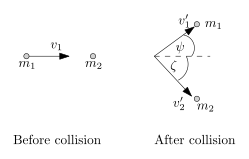
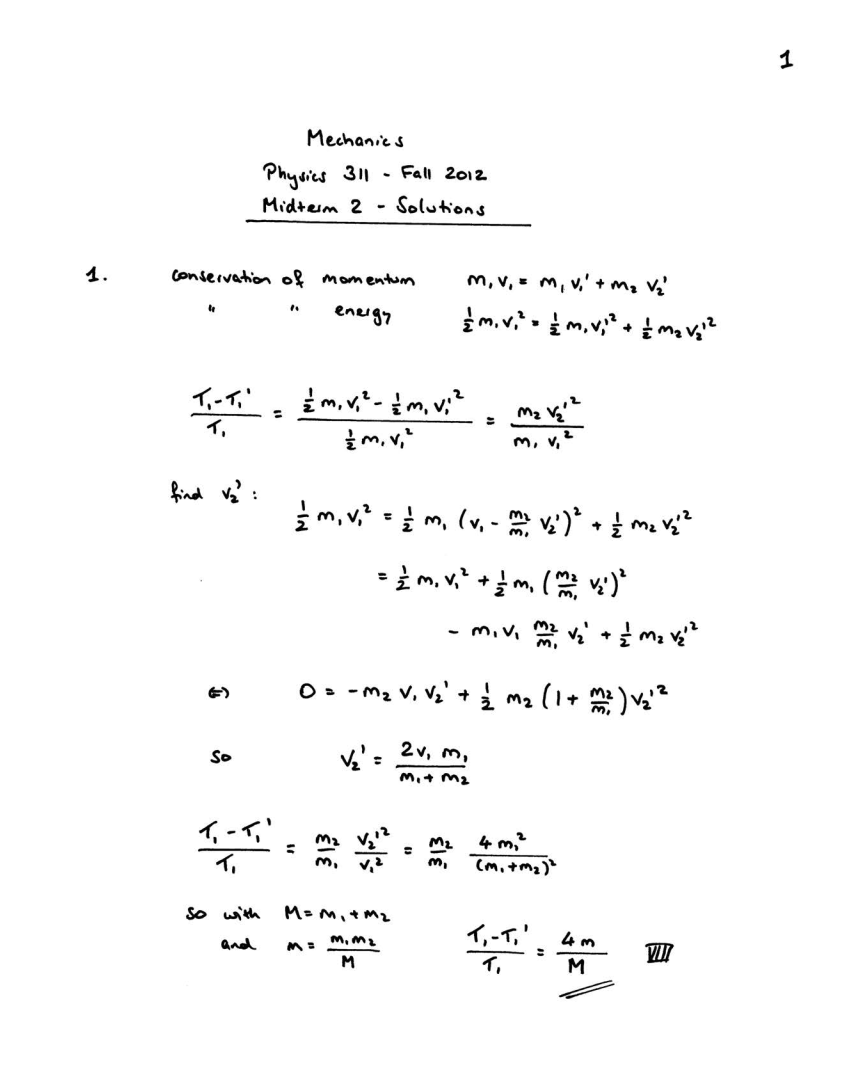
Conservation of Linear momentum gives
\begin{equation} m_{1}v_{1}=m_{1}v_{1}^{\prime }+m_{2}v_{2}^{\prime }\tag {1}\end{equation}
Conservation of energy gives
\[ \frac {1}{2}m_{1}v_{1}^{2}=\frac {1}{2}m_{1}\left ( v_{1}^{\prime }\right ) ^{2}+\frac {1}{2}m_{2}\left ( v_{2}^{\prime }\right ) ^{2}+Q \]
But since this is elastic
collision, then \(Q=0\). Hence the above becomes
\begin{equation} m_{1}v_{1}^{2}=m_{1}\left ( v_{1}^{\prime }\right ) ^{2}+m_{2}\left ( v_{2}^{\prime }\right ) ^{2}\tag {2}\end{equation}
The goal now is to eliminate \(v_{2}\) from (1) and (2) and
solve for \(v_{1}^{\prime }\) in terms of \(v_{1}\) to be able to answer the question. Let \(\frac {m_{2}}{m_{1}}=\gamma \), then (1,2) can be written
as
\begin{align} v_{1} & =v_{1}^{\prime }+\gamma v_{2}^{\prime }\tag {A1}\\ v_{1}^{2} & =\left ( v_{1}^{\prime }\right ) ^{2}+\gamma \left ( v_{2}^{\prime }\right ) ^{2}\tag {A2}\end{align}
We now move the \(m_{1}\) terms to one side,
\begin{align} v_{1}-v_{1}^{\prime } & =\gamma v_{2}^{\prime }\tag {C1}\\ v_{1}^{2}-\left ( v_{1}^{\prime }\right ) ^{2} & =\gamma \left ( v_{2}^{\prime }\right ) ^{2}\tag {C2}\end{align}
Dividing (2) by (1), using long division (this step is tricky, must be careful), gives
\begin{align} \frac {v_{1}^{2}-\left ( v_{1}^{\prime }\right ) ^{2}}{v_{1}-v_{1}^{\prime }} & =v_{2}^{\prime }\nonumber \\ v_{1}+v_{1}^{\prime } & =v_{2}^{\prime }\tag {3}\end{align}
We now replace \(v_{2}^{\prime }\) in (C1) with what (3) giving
\begin{align} v_{1}-v_{1}^{\prime } & =\gamma \left ( v_{1}+v_{1}^{\prime }\right ) \nonumber \\ v_{1}-\gamma v_{1} & =\gamma v_{1}^{\prime }+v_{1}^{\prime }\nonumber \\ v_{1}\left ( 1-\gamma \right ) & =v_{1}^{\prime }\left ( 1+\gamma \right ) \nonumber \\ v_{1}^{\prime } & =v_{1}\frac {\left ( 1-\gamma \right ) }{\left ( 1+\gamma \right ) }\tag {4}\end{align}
We achieved our goal of finding \(v_{1}^{\prime }\) in terms of \(v_{1}\). Now to answer the question. The question is asking
to find
\begin{equation} \Delta =\frac {T_{1}-T_{1}^{\prime }}{T_{1}}\tag {5}\end{equation}
Which is the fraction of kinetic energy loss of \(m_{1}\). So now we calculate the above, and see if it
gives the answer we are asked to show.
\begin{align*} \Delta & =\frac {\frac {1}{2}m_{1}v_{1}^{2}-\frac {1}{2}m_{1}\left ( v_{1}^{\prime }\right ) ^{2}}{\frac {1}{2}m_{1}v_{1}^{2}}\\ & =\frac {v_{1}^{2}-\left ( v_{1}^{\prime }\right ) ^{2}}{v_{1}^{2}}\end{align*}
Using (4) into the above gives
\[ \Delta =\frac {v_{1}^{2}-\left ( v_{1}\frac {\left ( 1-\gamma \right ) }{\left ( 1+\gamma \right ) }\right ) ^{2}}{v_{1}^{2}}\]
But \(\gamma =\frac {m_{2}}{m_{1}}\), expanding the above gives
\begin{align*} \Delta & =\frac {v_{1}^{2}-\left ( v_{1}\frac {\left ( 1-\frac {m_{2}}{m_{1}}\right ) }{\left ( 1+\frac {m_{2}}{m_{1}}\right ) }\right ) ^{2}}{v_{1}^{2}}\\ & =\frac {v_{1}^{2}-v_{1}^{2}\frac {\left ( 1-\frac {m_{2}}{m_{1}}\right ) ^{2}}{\left ( 1+\frac {m_{2}}{m_{1}}\right ) ^{2}}}{v_{1}^{2}}\\ & =1-\frac {\left ( 1-\frac {m_{2}}{m_{1}}\right ) ^{2}}{\left ( 1+\frac {m_{2}}{m_{1}}\right ) ^{2}}\\ & =1-\frac {\left ( m_{1}-m_{2}\right ) ^{2}}{\left ( m_{1}+m_{2}\right ) ^{2}}\\ & =\frac {\left ( m_{1}+m_{2}\right ) ^{2}-\left ( m_{1}-m_{2}\right ) ^{2}}{\left ( m_{1}+m_{2}\right ) ^{2}}\\ & =\frac {\left ( m_{1}^{2}+m_{2}^{2}+2m_{1}m_{2}\right ) -\left ( m_{1}^{2}+m_{2}^{2}-2m_{1}m_{2}\right ) }{\left ( m_{1}+m_{2}\right ) ^{2}}\end{align*}
Simplifying
\begin{align*} \Delta & =\frac {4m_{1}m_{2}}{\left ( m_{1}+m_{2}\right ) ^{2}}\\ & =4\frac {m_{1}m_{2}}{\left ( m_{1}+m_{2}\right ) }\frac {1}{\left ( m_{1}+m_{2}\right ) }\end{align*}
But \(m=\frac {m_{1}m_{2}}{m_{1}+m_{2}}\) which is the reduced mass, and \(M=m_{1}+m_{2}\). So the above becomes
\[ \Delta =\frac {4m}{M}\]
Which is the result we are asked to
show.
3.2.1.2.2 Problem 2
SOLUTION:
Part(a)
Let \(v_{1}\) be the speed in the lower circular orbit. Let \(v_{2}\) be the speed at the perigee just after speed
boost. Let \(GM\equiv \mu \). Since
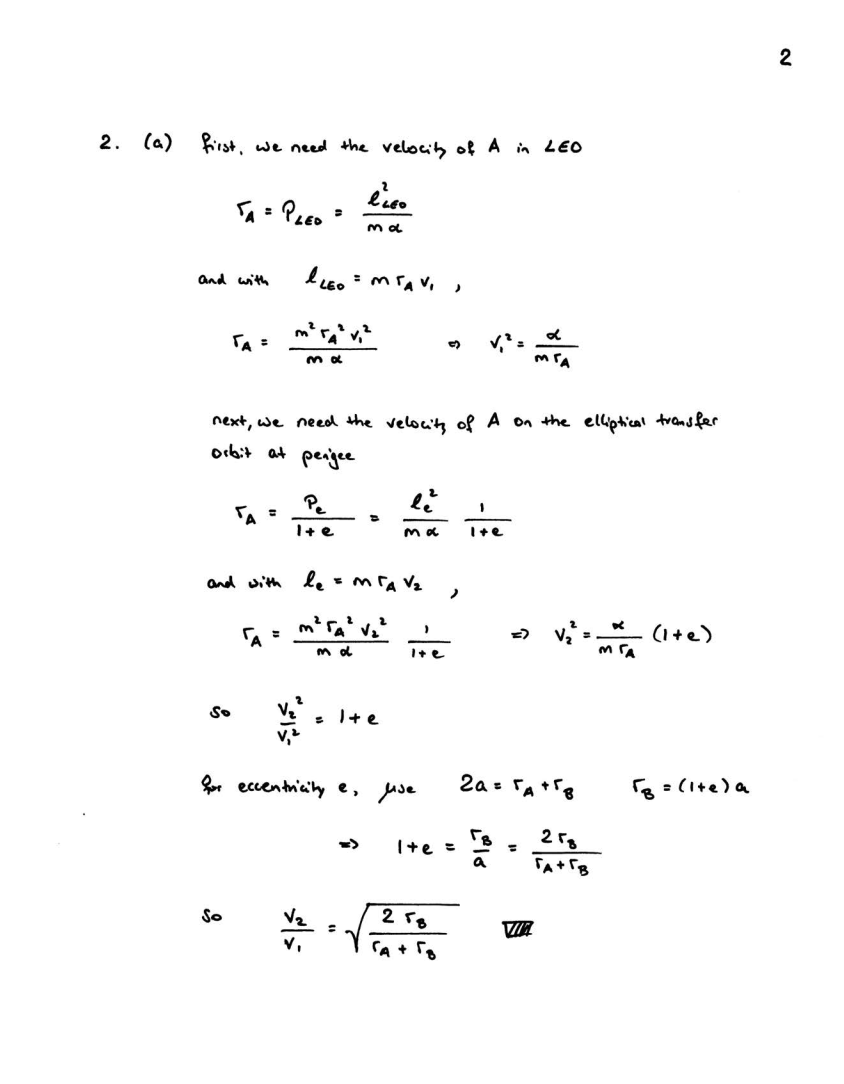
\begin{align*} v_{1} & =\sqrt {\frac {\mu }{r_{A}}}\\ v_{2} & =\sqrt {\mu \left ( \frac {2}{r_{A}}-\frac {1}{a}\right ) }\end{align*}
Where \(a=\frac {r_{A}+r_{B}}{2}\), then \(\frac {v_{2}}{v_{2}}\) can now be evaluated
\begin{align*} \frac {v_{2}}{v_{1}} & =\frac {\sqrt {\mu \left ( \frac {2}{r_{A}}-\frac {1}{a}\right ) }}{\sqrt {\frac {\mu }{r_{A}}}}\\ & =\sqrt {\frac {\mu \left ( \frac {2}{r_{A}}-\frac {1}{\frac {r_{A}+r_{B}}{2}}\right ) }{\frac {\mu }{r_{A}}}}\\ & =\sqrt {r_{A}\left ( \frac {2}{r_{A}}-\frac {2}{r_{A}+r_{B}}\right ) }\\ & =\sqrt {2-\frac {2r_{A}}{r_{A}+r_{B}}}\\ & =\sqrt {\frac {2\left ( r_{A}+r_{B}\right ) -2r_{A}}{r_{A}+r_{B}}}\\ & =\sqrt {\frac {2r_{B}}{r_{A}+r_{B}}}\end{align*}
Part(b)
Using the period for an ellipse given in the formulas and dividing this by half, since we are looking
for half the period, then
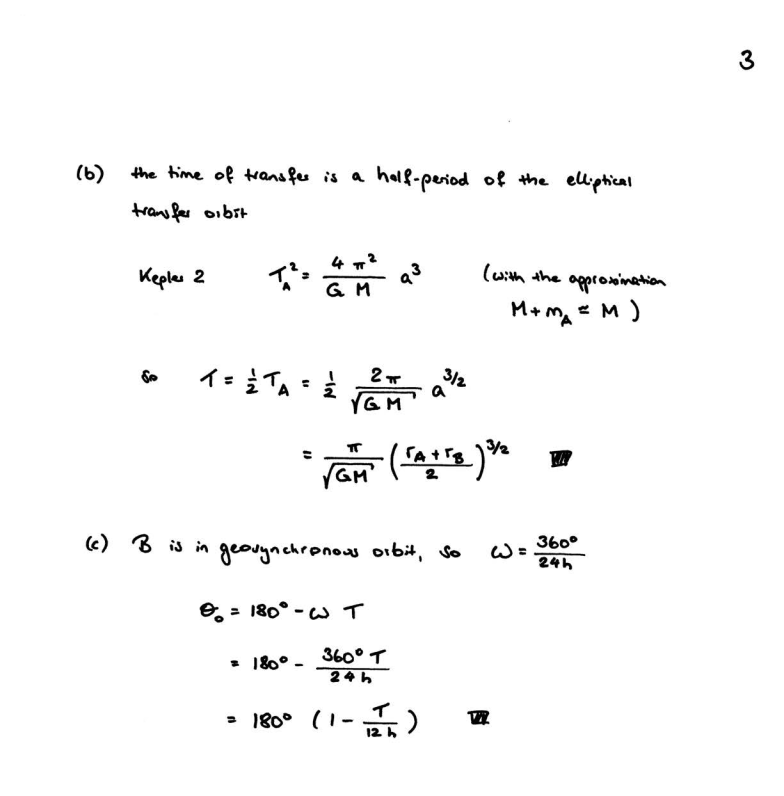
\begin{align*} T_{p} & =\pi \sqrt {\frac {a^{3}}{G\left ( m_{1}+M_{earth}\right ) }}\\ & =\pi \sqrt {\frac {\left ( \frac {r_{A}+r_{B}}{2}\right ) ^{3}}{G\left ( m_{1}+M_{e}\right ) }}\end{align*}
Assuming the mass of the satellite (\(m_{1}\)) is much smaller than \(M_{earth}\), then the above becomes
\[ T_{p}=\frac {\pi }{\sqrt {GM_{e}}}\sqrt {\left ( \frac {r_{A}+r_{B}}{2}\right ) ^{3}}\]
Part(c)
The time it takes \(B\) to travel one circle \(\left ( 2\pi \right ) \) is
\[ T_{c}=2\pi \sqrt {\frac {r_{B}^{3}}{GM}}\]
Therefore, the angle \(B\) travels during \(T_{p}\) is found by the
equating the ratios
\[ \frac {2\pi }{\alpha }\Leftrightarrow \frac {2\pi \sqrt {\frac {r_{B}^{3}}{GM}}}{T_{p}}\]
But \(\theta _{0}=\pi -\alpha \) (assuming the diagram given, where \(\alpha \) is the angle between \(B\) and the
apogee, while \(\theta \) is the angle between \(B\) and the perigee). Therefore we use the above to solve for \(\theta _{0}\)
\begin{align*} \frac {2\pi }{\pi -\theta _{0}} & =\frac {2\pi \sqrt {\frac {r_{B}^{3}}{GM}}}{T_{p}}\\ \frac {T_{p}}{\pi -\theta _{0}} & =\sqrt {\frac {r_{B}^{3}}{GM}}\\ \pi -\theta _{0} & =T_{p}\sqrt {\frac {GM}{r_{B}^{3}}}\\ \theta _{0} & =\pi -T_{p}\sqrt {\frac {GM}{r_{B}^{3}}}\\ & =\pi -\frac {\pi }{\sqrt {GM_{e}}}\sqrt {\left ( \frac {r_{A}+r_{B}}{2}\right ) ^{3}}\sqrt {\frac {GM}{r_{B}^{3}}}\end{align*}
Therefore
\[ \theta _{0}=\pi \left ( 1-\sqrt {\left ( \frac {r_{A}+r_{B}}{2r_{B}}\right ) ^{3}}\right ) \]
3.2.1.3 key solution to practice exam
3.2.2 Review Problems by TA
3.2.2.1 questions
3.2.2.2 key solution to review problems
3.2.3 Exam, Nov 16, 2015
3.2.3.1 questions
3.2.3.2 key solution