4.5 HW 5
This HW in one PDF
4.5.1 Problem 1
SOLUTION:
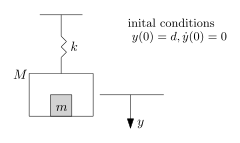
The block of mass \(m\) will leave the floor of the box when the vertical acceleration is large enough to
match the gravity acceleration \(g\). The equation of motion of the overall system is given by
\begin{equation} y^{\prime \prime }+\omega _{0}^{2}y=0 \tag {1}\end{equation}
Where \(\omega _{0}\) is the undamped natural frequency
\[ \omega _{0}=\sqrt {\frac {k}{M+m}}\]
The solution to (1) is
\begin{equation} y=A\cos \omega _{0}t+B\sin \omega _{0}t \tag {2}\end{equation}
Initial conditions are
used to find \(A,B\). Since at \(t=0\), \(y\left ( 0\right ) =d\), then from (2) we find
\[ A=d \]
Taking derivative of (2) gives
\begin{equation} y^{\prime }=-A\omega _{0}\sin \omega _{0}t+B\omega _{0}\cos \omega _{0}t \tag {3}\end{equation}
At \(t=0\), \(y^{\prime }\left ( 0\right ) =0\),
this gives \(B=0\). Therefore the full solution (2) becomes
\[ y=d\cos \omega _{0}t \]
The acceleration is now found as
\begin{align*} y^{\prime } & =-\omega _{0}d\sin \omega _{0}t\\ y^{\prime \prime } & =-\omega _{0}^{2}d\cos \omega _{0}t \end{align*}
The period is \(T_{p}=\frac {2\pi }{\omega _{0}}\). After one \(T_{p}\) from release the box will be the top. Therefore, the acceleration at that
moment is
\begin{align*} y^{\prime \prime }\left ( T_{p}\right ) & =-\omega _{0}^{2}d\cos \omega _{0}T_{p}\\ & =-\omega _{0}^{2}d\cos 2\pi \\ & =\omega _{0}^{2}d \end{align*}
The condition for \(m\) to just leave the floor of the box is when the above acceleration is the same as \(g\).
\begin{align*} \omega _{0}^{2}d & =g\\ d & =\frac {g}{\omega _{0}^{2}}\end{align*}
Therefore
\[ \fbox {$d=\frac {g}{k}\left ( M+m\right ) $}\]
4.5.2 Problem 2
SOLUTION:
4.5.2.1 Part (1)
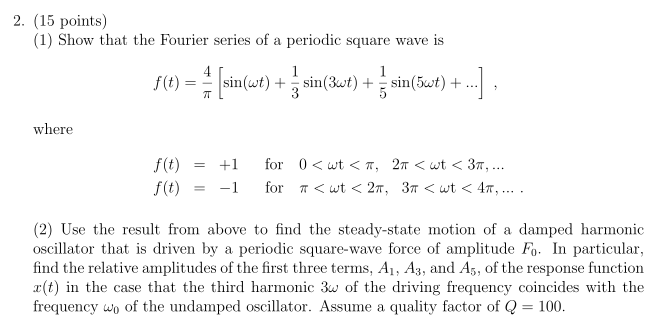
The function \(f\left ( t\right ) \) is an odd function, therefore we only need to evaluate \(b_{n}\) terms. To more
clearly see the period, the definition of \(f\left ( t\right ) \) is written as
\[ f\left ( t\right ) =\left \{ \begin {array} [c]{ccc}+1 & & 0<t<\frac {\pi }{\omega },\cdots \\ -1 & & \frac {\pi }{\omega }<t<\frac {2\pi }{\omega },\cdots \end {array} \right . \]
Therefore the period is
\[ T_{p}=\frac {2\pi }{\omega }\]
Finding
\(b_{n}\)
\begin{align*} b_{n} & =\frac {1}{\frac {T_{p}}{2}}\int _{0}^{T_{p}}f\left ( t\right ) \sin \left ( n\omega t\right ) dt\\ & =\frac {2}{\frac {2\pi }{\omega }}\left ( \int _{0}^{\frac {\pi }{\omega }}\left ( +1\right ) \sin \left ( n\omega t\right ) dt+\int _{\frac {\pi }{\omega }}^{\frac {2\pi }{\omega }}\left ( -1\right ) \sin \left ( n\omega t\right ) dt\right ) \\ & =\frac {\omega }{\pi }\left ( \int _{0}^{\frac {\pi }{\omega }}\sin \left ( n\omega t\right ) dt-\int _{\frac {\pi }{\omega }}^{\frac {2\pi }{\omega }}\sin \left ( n\omega t\right ) dt\right ) \\ & =\frac {\omega }{\pi }\left ( \left [ -\frac {\cos \left ( n\omega t\right ) }{n\omega }\right ] _{0}^{\frac {\pi }{\omega }}-\left [ -\frac {\cos \left ( n\omega t\right ) }{n\omega }\right ] _{\frac {\pi }{\omega }}^{\frac {2\pi }{\omega }}\right ) \\ & =\frac {\omega }{\pi }\left ( -\frac {1}{n\omega }\left [ \cos \left ( n\omega t\right ) \right ] _{0}^{\frac {\pi }{\omega }}+\frac {1}{n\omega }\left [ \cos \left ( n\omega t\right ) \right ] _{\frac {\pi }{\omega }}^{\frac {2\pi }{\omega }}\right ) \\ & =\frac {1}{n\pi }\left ( -\left [ \cos \left ( n\omega \frac {\pi }{\omega }\right ) -\cos \left ( 0\right ) \right ] +\left [ \cos \left ( n\omega \frac {2\pi }{\omega }\right ) -\cos \left ( n\omega \frac {\pi }{\omega }\right ) \right ] \right ) \\ & =\frac {1}{n\pi }\left ( -\left [ \cos \left ( n\pi \right ) -1\right ] +\left [ \cos \left ( 2n\pi \right ) -\cos \left ( n\pi \right ) \right ] \right ) \\ & =\frac {1}{n\pi }\left ( -\cos \left ( n\pi \right ) +1+\cos \left ( 2n\pi \right ) -\cos \left ( n\pi \right ) \right ) \\ & =\frac {1}{n\pi }\left ( -2\cos \left ( n\pi \right ) +\overset {1}{\overbrace {\cos \left ( 2n\pi \right ) }}+1\right ) \\ & =\frac {2}{n\pi }\left ( 1-\cos \left ( n\pi \right ) \right ) \end{align*}
And since \(n\) is an integer, then \(\cos \left ( n\pi \right ) =\left ( -1\right ) ^{n}\) and the above reduces to
\[ b_{n}=\frac {2}{n\pi }\left ( 1-\left ( -1\right ) ^{n}\right ) \]
Therefore
\[ b_{n}=\left \{ \begin {array} [c]{ccc}\frac {4}{n\pi } & & n=1,3,5,\cdots \\ 0 & & \text {otherwise}\end {array} \right . \]
Hence
\begin{align*} f\left ( t\right ) & =\sum _{n=1,3,5,\cdots }^{\infty }b_{n}\sin \left ( \omega nt\right ) \\ & =\sum _{n=1,3,5,\cdots }^{\infty }\frac {4}{n\pi }\sin \left ( \omega nt\right ) \end{align*}
Writing down few terms to see the sequence
\[ f\left ( t\right ) =\frac {4}{\pi }\left \{ \sin \left ( \omega t\right ) +\frac {1}{3}\sin \left ( 3\omega t\right ) +\frac {1}{5}\sin \left ( 5\omega t\right ) +\frac {1}{7}\sin \left ( 7\omega t\right ) +\cdots \right \} \]
4.5.2.2 Part (2)
When the system is driven by the above periodic square wave of amplitude \(F_{0}\), the steady state
response is the sum to the response of each harmonic in the Fourier series expansion of
the forcing function. Since the steady state response of a second order system to \(F_{n}\sin \left ( n\omega t\right ) \) is
given by
\[ y_{n}\left ( t\right ) =\frac {F_{n}/m}{\sqrt {\left ( \omega _{0}^{2}-\left ( n\omega \right ) ^{2}\right ) ^{2}+4\lambda _{n}^{2}\left ( n\omega \right ) ^{2}}}\sin \left ( n\omega t+\delta _{n}\right ) \]
Where the phase \(\delta _{n}\) is defined as
\[ \delta _{n}=\tan ^{-1}\frac {-2\lambda \left ( n\omega \right ) }{\omega _{0}^{2}-\left ( n\omega \right ) ^{2}}\]
Then the steady state response to \(f\left ( t\right ) =\sum _{n=1,3,5,\cdots }^{\infty }F_{0}\frac {4}{n\pi }\sin \left ( \omega nt\right ) \) is given
by
\begin{align} y_{ss}\left ( t\right ) & =\sum _{n=1,3,5,\cdots }^{\infty }\frac {4}{n\pi }\frac {F_{0}/m}{\sqrt {\left ( \omega _{0}^{2}-\left ( n\omega \right ) ^{2}\right ) ^{2}+4\lambda ^{2}\left ( n\omega \right ) ^{2}}}\sin \left ( n\omega t+\delta _{n}\right ) \tag {1}\\ & =\frac {4F_{0}}{\pi m}\sum _{n=1,3,5,\cdots }^{\infty }\frac {1}{n}\frac {\sin \left ( n\omega t+\delta _{n}\right ) }{\sqrt {\left ( \omega _{0}^{2}-\left ( n\omega \right ) ^{2}\right ) ^{2}+4\lambda ^{2}\left ( n\omega \right ) ^{2}}}\nonumber \end{align}
Looking at the first three responses gives
\begin{equation} y_{ss}\left ( t\right ) =\frac {4F_{0}}{\pi m}\left \{ \frac {\sin \left ( \omega t+\delta _{1}\right ) }{\sqrt {\left ( \omega _{0}^{2}-\omega ^{2}\right ) ^{2}+4\lambda ^{2}\omega ^{2}}}+\frac {1}{3}\frac {\sin \left ( 3\omega t+\delta _{3}\right ) }{\sqrt {\left ( \omega _{0}^{2}-\left ( 3\omega \right ) ^{2}\right ) ^{2}+4\lambda ^{2}\left ( 3\omega \right ) ^{2}}}+\frac {1}{5}\frac {\sin \left ( 5\omega t+\delta _{5}\right ) }{\sqrt {\left ( \omega _{0}^{2}-\left ( 5\omega \right ) ^{2}\right ) ^{2}+4\lambda ^{2}\left ( 5\omega \right ) ^{2}}}+\cdots \right \} \tag {2}\end{equation}
We are told that \(3\omega =\omega _{0}\) or \(\omega =\frac {1}{3}\omega _{0}\) and in addition, using using \(Q=\frac {\omega _{0}}{2\lambda }\) we
find
\begin{align*} 100 & =\frac {\omega _{0}}{2\lambda }\\ \lambda & =\frac {\omega _{0}}{200}\end{align*}
Using this \(\lambda \) and given value of \(\omega \) then the phase \(\delta _{n}\) becomes
\begin{align*} \delta _{n} & =\tan ^{-1}\frac {-2\lambda \left ( n\omega \right ) }{\omega _{0}^{2}-\left ( n\omega \right ) ^{2}}\\ & =\tan ^{-1}\frac {-2\left ( \frac {\omega _{0}}{200}\right ) \left ( n\frac {\omega _{0}}{3}\right ) }{\omega _{0}^{2}-\left ( n\frac {\omega _{0}}{3}\right ) ^{2}}\\ & =\tan ^{-1}\frac {3n}{100n^{2}-900}\end{align*}
Using the above phase in (2) gives
\begin{align*} y_{ss}\left ( t\right ) & =\frac {4F_{0}}{\pi m}\left \{ \frac {\sin \left ( \frac {\omega _{0}}{3}t+\tan ^{-1}\frac {-3}{800}\right ) }{\sqrt {\left ( \omega _{0}^{2}-\left ( \frac {\omega _{0}}{3}\right ) ^{2}\right ) ^{2}+4\left ( \frac {\omega _{0}}{200}\right ) ^{2}\left ( \frac {\omega _{0}}{3}\right ) ^{2}}}+\frac {\frac {1}{3}\sin \left ( \omega _{0}t+\frac {\pi }{2}\right ) }{\sqrt {\left ( \omega _{0}^{2}-\left ( 3\frac {\omega _{0}}{3}\right ) ^{2}\right ) ^{2}+4\left ( \frac {\omega _{0}}{200}\right ) ^{2}\left ( 3\frac {\omega _{0}}{3}\right ) ^{2}}}+\frac {\frac {1}{5}\sin \left ( 5\frac {\omega _{0}}{3}t+\tan ^{-1}\frac {3}{320}\right ) }{\sqrt {\left ( \omega _{0}^{2}-\left ( 5\frac {\omega _{0}}{3}\right ) ^{2}\right ) ^{2}+4\left ( \frac {\omega _{0}}{200}\right ) ^{2}\left ( 5\frac {\omega _{0}}{3}\right ) ^{2}}}+\cdots \right \} \\ & =\frac {4}{\pi }\frac {F_{0}}{m}\left \{ \frac {\sin \left ( \frac {\omega _{0}}{3}t-\tan ^{-1}\frac {3}{800}\right ) }{\sqrt {\frac {640\,009}{810\,000}\omega _{0}^{4}}}+\frac {1}{3}\frac {\sin \left ( \omega _{0}t+\frac {\pi }{2}\right ) }{\sqrt {\frac {1}{10\,000}\omega _{0}^{4}}}+\frac {1}{5}\frac {\sin \left ( 5\frac {\omega _{0}}{3}t+\tan ^{-1}\frac {3}{320}\right ) }{\sqrt {\frac {102\,409}{32\,400}\omega _{0}^{4}}}+\cdots \right \} \\ & =\frac {4}{\pi }\frac {F_{0}}{m}\left \{ 1.125\,\frac {\sin \left ( 0.333\omega _{0}t-\tan ^{-1}\frac {3}{800}\right ) }{\omega _{0}^{2}}+33.333\frac {\sin \left ( \omega _{0}t+\frac {\pi }{2}\right ) }{\omega _{0}^{2}}+0.11249\frac {\sin \left ( 1.6667\omega _{0}t+\tan ^{-1}\frac {3}{320}\right ) }{\omega _{0}^{2}}+\cdots \right \} \end{align*}
The relative amplitudes of \(A_{1},A_{3},A_{5}\) are given by
\[ \left \{ 1.125,33.333,0.11249\right \} \]
We see that the third harmonic \(\left ( n=3\right ) \) has the largest amplitude,
since this is where \(3\omega =\omega _{0}\). In normalized size, dividing all amplitudes by the smallest amplitude
gives
\[ \left \{ A_{1},A_{3},A_{5}\right \} _{normalized}=\left \{ 10,296,1\right \} \]
4.5.3 Problem 3
SOLUTION:
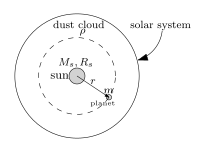
The total force on the planet \(m\) is due to the mass inside the region centered at the center of the sun.
The mass outside can be ignored since its effect cancels out. Let the radius of the sun be \(R_{sun}\), then the
total mass that pulls the planet toward the center of the solar system is given by
\[ M_{total}=M_{sun}+\frac {4}{3}\pi \left ( r^{3}-R_{sun}^{3}\right ) \rho \]
The force on the
planet is therefore
\begin{align*} \bar {F} & =-\frac {GM_{total}m}{r^{2}}\hat {r}\\ & =-\frac {G\left ( M_{sun}+\frac {4}{3}\pi \left ( r^{3}-R_{sun}^{3}\right ) \rho \right ) m}{r^{2}}\hat {r}\end{align*}
Where \(\hat {r}\) is a unit vector pointing from the sun towards the planet \(m\) and \(G\) is the gravitational
constant and \(\rho \) is the cloud density.
4.5.4 Problem 4
SOLUTION:
4.5.4.1 Part (1)
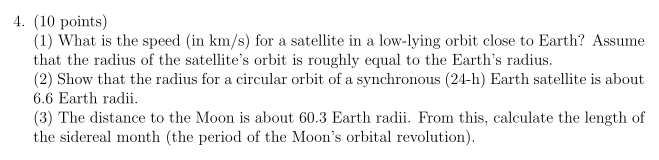
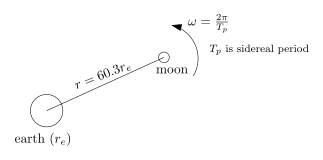
The force on the satellite is \(mr_{e}\omega ^{2}\) where \(r_{e}\) is taken as the earth radius since this is low-lying orbit.
Therefore
\[ \frac {GM_{e}m}{r_{e}^{2}}=mr_{e}\omega ^{2}\]
But \(v=r_{e}\omega \) where \(v\) is the satellite speed we want to find. Hence \(\omega ^{2}=\frac {v^{2}}{r_{e}^{2}}\) and the above
becomes
\begin{align*} \frac {GM_{e}}{r_{e}^{2}} & =r_{e}\frac {v^{2}}{r_{e}^{2}}\\ v & =\sqrt {\frac {GM_{e}}{r_{e}}}\\ & =\sqrt {\frac {\left ( 6.67408\times 10^{-11}\right ) \left ( 5.972\times 10^{24}\right ) }{6.371\times 10^{6}}}\\ & =7909\,.6\text { meter/sec}\\ & =7.9\text { km/sec}\end{align*}
4.5.4.2 Part (2)
Let the radius of the satellite orbit be \(r\). Using
\begin{align*} \frac {GM_{e}m}{r^{2}} & =mr\omega ^{2}\\ r & =\left ( \frac {GM_{e}}{\omega ^{2}}\right ) ^{\frac {1}{3}}\end{align*}
where \(\omega =\frac {2\pi }{T_{p}}\) where \(T_{p}\) is the period of the satellite. But for synchronous satellite, this period is \(24\) hrs. Hence
the above becomes
\begin{align*} r & =\left ( \frac {GM_{e}}{\left ( \frac {2\pi }{T_{p}}\right ) ^{2}}\right ) ^{\frac {1}{3}}\\ & =\left ( \frac {\left ( 6.67408\times 10^{-11}\right ) \left ( 5.972\times 10^{24}\right ) }{\left ( \frac {2\pi }{24\left ( 60\right ) \left ( 60\right ) }\right ) ^{2}}\right ) ^{\frac {1}{3}}\\ & =4.224\times 10^{7}\text { meter}\end{align*}
But radius of earth is \(r_{e}=6.371\times 10^{6}\) meters. Hence
\[ \frac {r}{r_{e}}=\frac {4.224\times 10^{7}}{6.371\times 10^{6}}=6.63 \]
4.5.4.3 Part (3)
From
\begin{align*} \frac {GM_{e}m}{r^{2}} & =mr\omega ^{2}\\ \frac {GM_{e}}{r^{3}} & =\omega ^{2}\\ \frac {GM_{e}}{r^{3}} & =\left ( \frac {2\pi }{T_{p}}\right ) ^{2}\end{align*}
We solve for \(T_{p}\), hence
\begin{align*} \frac {2\pi }{T_{p}} & =\sqrt {\frac {GM_{e}}{r^{3}}}\\ T_{p} & =\frac {2\pi }{\sqrt {\frac {GM_{e}}{r^{3}}}}=\frac {2\pi }{\sqrt {\frac {\left ( 6.67408\times 10^{-11}\right ) \left ( 5.972\times 10^{24}\right ) }{\left ( \left ( 60.3\right ) \left ( 6.371\times 10^{6}\right ) \right ) ^{3}}}}\\ & =2.369\,8\times 10^{6}\text { sec}\end{align*}
Therefore, in days, the above becomes
\begin{align*} T_{p} & =\frac {2.369\,8\times 10^{6}}{\left ( 24\right ) \left ( 60\right ) \left ( 60\right ) }\\ & =27.428\text { days}\end{align*}
4.5.5 Problem 5
SOLUTION:
4.5.5.1 Part(1)
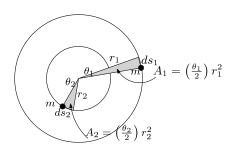
From the above diagram, where we have two particles of same mass \(m\) in two circular orbits. The
area of each sector is given by
\[ A=\frac {\theta }{2}r^{2}\]
The time rate of each sector area is
\begin{equation} \frac {dA_{1}}{dt}=\frac {\dot {\theta }_{1}}{2}r_{1}^{2} \tag {1}\end{equation}
Similarly
\begin{equation} \frac {dA_{2}}{dt}=\frac {\dot {\theta }_{2}}{2}r_{2}^{2} \tag {2}\end{equation}
Since we have a central force, then this force attracts
each mass with a force given by \(f=mr\dot {\theta }^{2}\). Therefore \(f_{r_{1}}=mr_{1}\dot {\theta }_{1}^{2}\), Similarly \(f_{r_{2}}=mr_{2}\dot {\theta }_{2}^{2}\). Substituting for \(\dot {\theta }\) from these expressions
back into (1) and (2) gives
\begin{equation} \frac {dA_{1}}{dt}=\sqrt {\frac {f_{1}}{mr_{1}}}\frac {r_{1}^{2}}{2} \tag {1B}\end{equation}
Similarly
\begin{equation} \frac {dA_{2}}{dt}=\sqrt {\frac {f_{1}}{mr_{1}}}\frac {r_{1}^{2}}{2} \tag {2B}\end{equation}
We are told the areal speeds are the same, therefore equating
the above gives
\begin{align*} \frac {dA_{1}}{dt} & =\frac {dA_{2}}{dt}\\ \sqrt {\frac {f_{1}}{mr_{1}}}\frac {r_{1}^{2}}{2} & =\sqrt {\frac {f_{2}}{mr_{2}}}\frac {r_{1}^{2}}{2}\\ \frac {f_{1}}{mr_{1}}\frac {r_{1}^{4}}{4} & =\frac {f_{2}}{mr_{2}}\frac {r_{2}^{2}}{4}\\ f_{1}r_{1}^{3} & =f_{2}r_{2}^{3}\end{align*}
Hence
\[ \frac {f_{r_{1}}}{f_{r_{2}}}=\frac {r_{2}^{3}}{r_{1}^{3}}\]
This says that, since we using the same mass, that the force \(f\left ( r\right ) \) on a mass is inversely
proportional to the cube of the mass distance from the center. To see this more clearly, let \(r_{1}=1\)
then
\[ f_{r_{2}}=\frac {1}{r_{2}^{3}}f_{r_{1}}\]
So if we move the mass from \(r_{1}=1\) to say 3 times as far to \(r_{2}=3\), then the force on the same mass becomes \(\frac {1}{27}\)
smaller than it was.
4.5.5.2 Part(2)
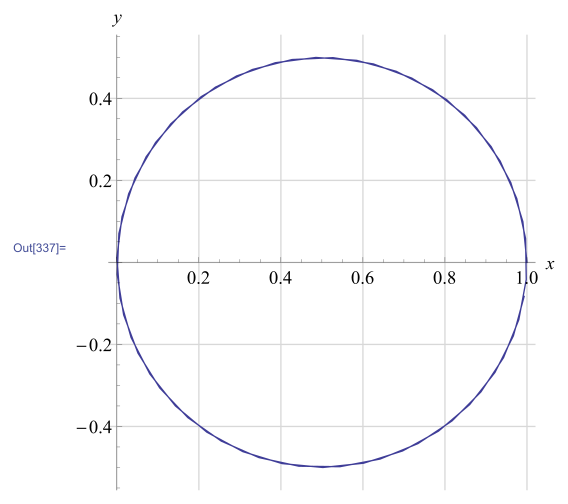
The orbit first is plotted as follows
Clear[r0, r]
r0 = 1;
r[angle_] := r0 Cos[angle]
xyData = Table[{r[a] Cos[a], r[a] Sin[a]}, {a, 0, 2 Pi, .1}];

ListLinePlot[xyData, GridLines -> Automatic,
 GridLinesStyle -> LightGray, AxesOrigin -> {0, 0},
 AxesLabel -> {x, y}, BaseStyle -> 14, PlotTheme -> "Classic",
 AspectRatio -> Automatic]
Which produces the following plot
Using 8.21 in textbook, page 293
\begin{equation} \frac {d^{2}}{d\theta ^{2}}\left ( \frac {1}{r}\right ) +\frac {1}{r}=-\frac {\mu r^{2}}{l^{2}}F\left ( r\right ) \tag {1}\end{equation}
Where \(\mu \) is the reduces mass, \(l\) is the angular momentum and \(F\left ( r\right ) \) is the force we are solving for. Since \(r=r_{0}\cos \theta \)
then
\begin{align} \frac {d^{2}}{d\theta ^{2}}\left ( \frac {1}{r}\right ) & =\frac {d}{d\theta }\left ( \frac {d}{d\theta }\frac {1}{r}\right ) =\frac {d}{d\theta }\left ( \frac {d}{d\theta }\frac {1}{r_{0}\cos \theta }\right ) \nonumber \\ & =\frac {d}{d\theta }\left ( \frac {\left ( -1\right ) \left ( -\sin \theta \right ) }{r_{0}\cos ^{2}\theta }\right ) \nonumber \\ & =\frac {d}{d\theta }\left ( \frac {\sin \theta }{r_{0}\cos ^{2}\theta }\right ) \nonumber \\ & =\left ( \frac {\cos \theta }{r_{0}\cos ^{2}\theta }+\frac {2\sin ^{2}\theta }{r_{0}\cos ^{3}\theta }\right ) \nonumber \\ & =\left ( \frac {1}{r_{0}\cos \theta }+\frac {2\sin ^{2}\theta }{r_{0}\cos ^{3}\theta }\right ) \tag {2}\end{align}
But from \(r=r_{0}\cos \theta \) we see that \(\cos \theta =\frac {r}{r_{0}}\) and \(\sin ^{2}\theta =1-\cos ^{2}\theta =1-\left ( \frac {r}{r_{0}}\right ) ^{2}\), hence (2) becomes
\begin{align*} \frac {d^{2}}{d\theta ^{2}}\left ( \frac {1}{r}\right ) & =\left ( \frac {1}{r_{0}\left ( \frac {r}{r_{0}}\right ) }+\frac {2\left ( 1-\left ( \frac {r}{r_{0}}\right ) ^{2}\right ) }{r_{0}\left ( \frac {r}{r_{0}}\right ) ^{3}}\right ) \\ & =\left ( \frac {1}{r}+\frac {2\left ( 1-\frac {r^{2}}{r_{0}^{2}}\right ) }{\frac {r^{3}}{r_{0}^{2}}}\right ) \\ & =\left ( \frac {1}{r}+\frac {2-\frac {2r^{2}}{r_{0}^{2}}}{\frac {r^{3}}{r_{0}^{2}}}\right ) \\ & =\left ( \frac {1}{r}+\frac {2r_{0}^{2}-2r^{2}}{r^{3}}\right ) \\ & =\frac {r^{2}+2r_{0}^{2}-2r^{2}}{r^{3}}\\ & =\frac {2r_{0}^{2}-r^{2}}{r^{3}}\end{align*}
Therefore (1) becomes
\begin{align*} \frac {2r_{0}^{2}-r^{2}}{r^{3}}+\frac {1}{r} & =-\frac {\mu r^{2}}{l^{2}}F\left ( r\right ) \\ \frac {2r_{0}^{2}-r^{2}+r^{2}}{r^{3}} & =-\frac {\mu r^{2}}{l^{2}}F\left ( r\right ) \end{align*}
Solving for \(F\left ( r\right ) \)
\begin{align*} F\left ( r\right ) & =-\frac {2l^{2}r_{0}^{2}}{\mu r^{5}}\\ & =-\left ( \frac {2l^{2}r_{0}^{2}}{\mu }\right ) \frac {1}{r^{5}}\end{align*}
The above shows that the force is an inverse fifth power.
4.5.6 HW 5 key solution