4.6 HW 6
This HW in one PDF
4.6.1 Problem 1
SOLUTION:
From the vis-viva relation
\begin{equation} v_{perigee}=\sqrt {\frac {\alpha }{m}\left ( \frac {2}{r_{p}}-\frac {1}{a}\right ) } \tag {1}\end{equation}
Where \(m\) is the reduced mass and \(\alpha =GM_{earth}m_{satt}\), which reduces to \(GM_{earth}\) and known
constant called the Standard gravitational parameter which for earth is (From table)
\[ \frac {\alpha }{m}=398600\text { km}^{3}/s^{2}\]
And
\begin{align*} r_{p} & =220+6378\\ & =6598\text { km}\end{align*}
Where \(6378\) is the equatorial radius of earth. And \(v_{perigee}=28070\) km/h. Therefore, we use (1) to solve for \(a\), the length
of the semimajor axes of the elliptical orbit of the satellite around the earth. From (1), by squaring
both sides
\begin{align*} v_{p}^{2} & =\frac {\alpha }{m}\left ( \frac {2}{r_{p}}-\frac {1}{a}\right ) \\ \left ( \frac {28070}{60\times 60}\right ) ^{2} & =398600\left ( \frac {2}{220+6378}-\frac {1}{a}\right ) \end{align*}
Solving for \(a\) gives
\[ a=6640\text { km}\]
Hence the apogee distance is
\[ 2a=13280\text { km}\]
We can also find
\begin{align*} r_{a} & =2a-r_{p}\\ & =13280-6598\\ & =6682\text { km}\end{align*}
When the satellite is at the apogee, it will be above the earth at height of
\begin{align*} h_{a} & =r_{a}-r_{earth}\\ & =6682-6378\\ & =304\text { km}\end{align*}
The period \(T\) is given by
\begin{align*} T & =2\pi \sqrt {\frac {a^{3}}{\frac {\alpha }{m}}}\\ & =2\pi \sqrt {\frac {6640^{3}}{398600}}\\ & =5385\text { sec}\\ & =\frac {5385}{60\times 60}=1.496\text { hr}\end{align*}
4.6.2 Problem 2
SOLUTION:
The total energy is
\[ E=\frac {1}{2}m\dot {r}^{2}+U_{effective}\]
The escape velocity is when \(U_{effective}=0\) , therefore
\[ 0=-U+\frac {l^{2}}{2mr^{2}}\]
But angular momentum \(l=mrv\) and \(U=\frac {GM_{e}m}{r}\), hence
the above becomes
\begin{align} 0 & =-\frac {GM_{e}m}{r}+\frac {m^{2}r^{2}v^{2}}{2mr^{2}}\nonumber \\ & =-\frac {GM_{e}m}{r}+\frac {mv^{2}}{2}\nonumber \\ & =-\frac {GM_{e}}{r}+\frac {v^{2}}{2} \tag {1}\end{align}
Now we are given that the satellite was at \(r=200+6378=6578\) km (this is \(r_{p}\) for the new orbit as well). Using \(GM_{e}=398600\) km\(^{3}/s^{2}\) from
tables then we solve now for \(v\) in (1), which will be the new velocity. Hence
\begin{align*} 0 & =-\frac {398600}{6578}+\frac {v^{2}}{2}\\ v & =11.009\text { km/sec}\end{align*}
Before this, the spacecraft was in circular orbit. So its speed was
\begin{align*} v_{c} & =\sqrt {\frac {\alpha }{m}\frac {1}{r}}\\ & =\sqrt {\frac {398600}{6578}}\\ & =7.784\text { km/sec }\end{align*}
The difference is the minimum speed kick needed, which is
\[ 11.009-7.784=3.225\text { km/sec}\]
This orbit is parabolic since \(U_{effective}=0\) as seen on
the \(U_{effective}\) vs. \(r\) graph. parabolic is the first orbit beyond elliptic that do not contain turn points. The next
orbit is hyperbolic.
4.6.3 Problem 3
SOLUTION:
4.6.3.1 Part (1)
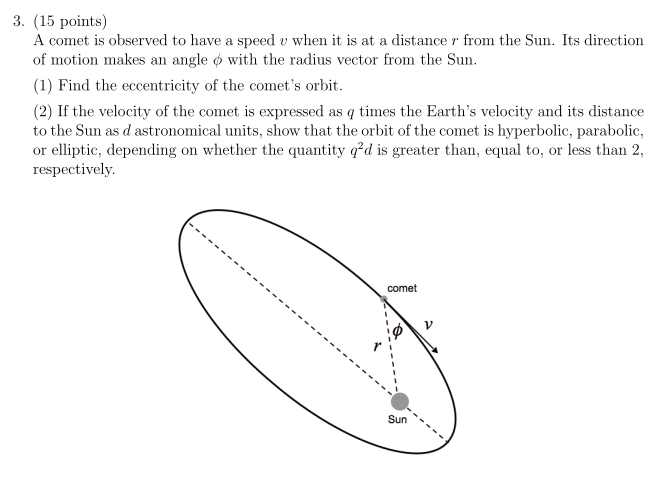
Eccentricity is defined as (for all conic sections)
\begin{equation} e=\sqrt {1+\frac {2El^{2}}{m\alpha ^{2}}} \tag {1}\end{equation}
Where \(\alpha =GM_{sun}m\) and \(l\) is the angular momentum
\begin{align*} l & =m\left \vert \mathbf {r}\times \mathbf {v}\right \vert \\ & =mrv\sin \phi \end{align*}
Therefore (1) becomes
\[ e=\sqrt {1+\frac {2E\left ( rv\sin \phi \right ) ^{2}}{m\left ( GM_{sun}\right ) ^{2}}}\]
The energy of the comet is given by \(E=\frac {1}{2}mv^{2}-\frac {GM_{sun}m}{r}\), then the above becomes
\begin{align*} e & =\sqrt {1+\frac {2\left ( \frac {1}{2}mv^{2}-\frac {GM_{sun}m}{r}\right ) \left ( rv\sin \phi \right ) ^{2}}{m\left ( GM_{sun}\right ) ^{2}}}\\ & =\sqrt {1+\left ( \frac {2\left ( \frac {1}{2}mv^{2}-\frac {GM_{sun}m}{r}\right ) }{m}\right ) \left ( \frac {rv\sin \phi }{GM_{sun}}\right ) ^{2}}\\ & =\sqrt {1+\left ( v^{2}-\frac {2GM_{sun}}{r}\right ) \left ( \frac {rv\sin \phi }{GM_{sun}}\right ) ^{2}}\end{align*}
4.6.3.2 Part (2)
Let \(v=qv_{e}\) where \(v_{e}\) is earth velocity around the sun and let \(r=dr_{e}\) where \(r_{e}\) is the astronomical unit (the distance
between the earth and sun) then result of part (1) becomes
\begin{equation} e=\sqrt {1+\left ( \left ( qv_{e}\right ) ^{2}-\frac {2GM_{sun}}{dr_{e}}\right ) \left ( \frac {dr_{e}qv_{e}\sin \phi }{GM_{sun}}\right ) ^{2}} \tag {2}\end{equation}
Looking at the earth/sun system, we
know that
\begin{align*} \frac {GM_{sun}m_{earth}}{r_{e}^{2}} & =\frac {m_{earth}v_{e}^{2}}{r_{e}}\\ \frac {GM_{sun}}{r_{e}} & =v_{e}^{2}\\ GM_{sun} & =r_{e}v_{e}^{2}\end{align*}
Replacing \(GM_{sun}\) in (2) by the above result gives
\begin{align*} e & =\sqrt {1+\left ( \left ( qv_{e}\right ) ^{2}-\frac {2r_{e}v_{e}^{2}}{dr_{e}}\right ) \left ( \frac {dr_{e}qv_{e}\sin \phi }{r_{e}v_{e}^{2}}\right ) ^{2}}\\ & =\sqrt {1+\left ( \left ( qv_{e}\right ) ^{2}-\frac {2v_{e}^{2}}{d}\right ) \left ( \frac {dq\sin \phi }{v_{e}}\right ) ^{2}}\\ & =\sqrt {1+\left ( q^{2}-\frac {2}{d}\right ) \left ( dq\sin \phi \right ) ^{2}}\\ & =\sqrt {1+\left ( \frac {q^{2}d-2}{d}\right ) \left ( dq\sin \phi \right ) ^{2}}\end{align*}
We are now ready to answer the final part. If \(q^{2}d=2\) then \(e=1\) which means it is parabolic. If \(q^{2}d>2\) then \(\left ( \frac {q^{2}d-2}{d}\right ) \) is
positive and the expression inside \(\sqrt {.}\) is larger than one, and hence \(e>1\), which means the orbit is
hyperbolic. Finally, if \(q^{2}d<2\) then \(\left ( \frac {q^{2}d-2}{d}\right ) \) is negative, and the expression inside \(\sqrt {.}\) is less than one, which means \(e<1\)
and hence the orbit is elliptic.
4.6.4 Problem 4
SOLUTION:
The angular momentum \(l\) is constant. At perigee, where the speed is maximum, we have
\[ l_{p}=mv_{\max }r_{p}\]
And at
apogee, where the speed is minimum, we have
\[ l_{a}=mv_{\min }r_{a}\]
Since \(l\) is constant, then
\begin{align} mv_{\max }r_{p} & =mv_{\min }r_{a}\nonumber \\ v_{\max }r_{p} & =v_{\min }r_{a}\tag {1}\end{align}
But
\begin{align*} r_{a} & =a\left ( 1+e\right ) \\ r_{p} & =a\left ( 1-e\right ) \end{align*}
Hence (1) becomes
\begin{align*} v_{\max }a\left ( 1-e\right ) & =v_{\min }a\left ( 1+e\right ) \\ v_{\max }\left ( 1-e\right ) & =v_{\min }\left ( 1+e\right ) \\ v_{\max }-ev_{\max } & =v_{\min }+ev_{\min }\\ v_{\max }-v_{\min } & =e\left ( v_{\min }+v_{\max }\right ) \\ e & =\frac {v_{\max }-v_{\min }}{v_{\min }+v_{\max }}\end{align*}
Replacing \(v_{\max }=v+v_{0}\) and \(v_{\min }=v-v_{0}\) gives
\begin{align*} e & =\frac {\left ( v+v_{0}\right ) -\left ( v-v_{0}\right ) }{\left ( v+v_{0}\right ) +\left ( v-v_{0}\right ) }\\ & =\frac {2v_{0}}{2v}\\ & =\frac {v_{0}}{v}\end{align*}
4.6.5 Problem 5
SOLUTION:
4.6.5.1 Part (1)
In this calculation, the standard symbol \(\mu \) is used for \(GM_{earth}\) which is the Standard gravitational parameter
(in class, we used \(\frac {\alpha }{m}\) for this same parameter). For earth
\[ \mu =398600\text { km}^{3}/s^{2}\]
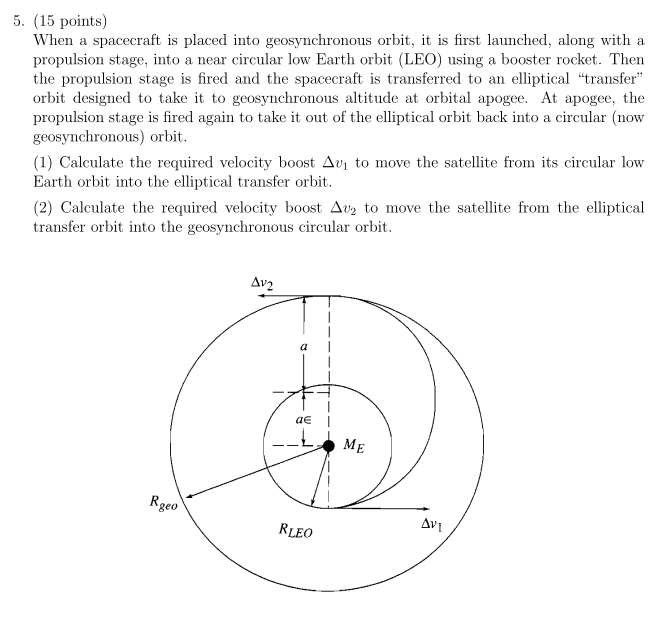
The first step is to find \(a\) for the transfer
ellipse. This is given by
\[ a=\frac {R_{LEO}+R_{GEO}}{2}\]
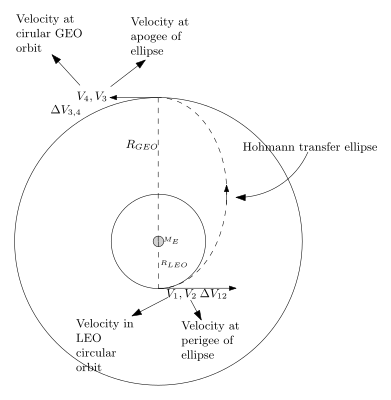
Next, we first find \(V_{1}\), which is velocity in the LEO circular orbit just
before initial kick to \(V_{2}\). Since this is circular, the speed is given by
\[ V_{1}=\sqrt {\frac {\mu }{R_{LEO}}}\]
Next step is to find \(V_{2}\),
which is the speed at the perigee of the ellipse (the transfer orbit). This is given by
the standard vis-viva relation
\begin{equation} V_{2}=\sqrt {\mu \left ( \frac {2}{R_{LEO}}-\frac {1}{a}\right ) }\tag {1}\end{equation}
Where \(R_{LEO}=r_{perigee}\) for the ellipse. Now that we found \(V_{2}\) and \(V_{1}\), then
\begin{align*} \Delta V_{12} & =V_{2}-V_{1}\\ & =\sqrt {\mu \left ( \frac {2}{R_{LEO}}-\frac {1}{a}\right ) }-\sqrt {\frac {\mu }{R_{LEO}}}\end{align*}
4.6.5.2 Part (2)
When at the apogee of the transfer ellipse, the speed is given by
\[ V_{3}=\sqrt {\mu \left ( \frac {2}{R_{GEO}}-\frac {1}{a}\right ) }\]
We now want to be of GEO
circular orbit, hence
\[ V_{4}=\sqrt {\frac {\mu }{R_{GEO}}}\]
And therefore, the speed boost is
\begin{align*} \Delta V_{34} & =V_{4}-V_{3}\\ & =\sqrt {\frac {\mu }{R_{GEO}}}-\sqrt {\mu \left ( \frac {2}{R_{GEO}}-\frac {1}{a}\right ) }\end{align*}
4.6.6 HW 6 key solution