4.2 HW 2
This HW in one PDF
4.2.1 Problem 1
SOLUTION
\[ L=T-U \]
Where \(U\) is the potential energy of the whole system and \(T\) is the kinetic energy of the whole system.
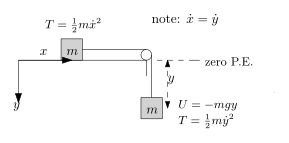
The two masses will have the same speed since the string does not stretch. This means \(\dot {x}=\dot {y}\)
\[ T=\frac {1}{2}m\dot {x}^{2}+\frac {1}{2}m\dot {y}^{2}\]
Since \(\dot {x}=\dot {y}\), we
can write the above as
\[ T=m\dot {y}^{2}\]
The potential energy \(U\), using zero as the level shown in the above diagram
is
\[ U=-mgy \]
Hence the Lagrangian is \(L=T-U\) or
\[ \fbox {$L=m\dot {y}^2+mgy$}\]
To find equation of motion
\[ \frac {d}{dt}\frac {\partial L}{\partial y^{\prime }}-\frac {\partial L}{\partial y}=0 \]
But \(\frac {\partial L}{\partial y}=mg\) and \(\frac {d}{dt}\frac {\partial L}{\dot {y}}=\frac {d}{dt}\left ( 2m\dot {y}\right ) =2m\ddot {y}\), hence the above becomes
\[ 2m\ddot {y}-mg=0 \]
Or
\[ \fbox {$\ddot {y}=\frac {g}{2}$}\]
This is an acceleration in the downward direction as down was taken positive as shown in the
diagram. Since both masses move with same acceleration (magnitude is the same, but direction is
ofcourse is as shown in the diagram), then the acceleration of the top mass is also the
same
\[ \fbox {$\ddot {x}=\frac {g}{2}$}\]
4.2.2 Problem 2
SOLUTION
\[ ds=\sqrt {dx^{2}+dy^{2}}\]
Therefore we want to minimize
\[ J=\int ds=\int \sqrt {dx^{2}+dy^{2}}=\int \sqrt {1+\left ( \frac {dy}{dx}\right ) ^{2}}dx=\int \sqrt {1+\left ( y^{\prime }\right ) ^{2}}dx \]
Hence
\[ f=\sqrt {1+\left ( y^{\prime }\right ) ^{2}}\]
And the Euler Lagrangian equation is \(\frac {\partial f}{\partial y}-\frac {d}{dx}\left ( \frac {\partial f}{\partial y^{\prime }}\right ) =0\), but
\begin{align*} \frac {\partial f}{\partial y} & =0\\ \frac {\partial f}{\partial y^{\prime }} & =\frac {1}{2}\frac {2y^{\prime }}{\sqrt {1+\left ( y^{\prime }\right ) ^{2}}}\end{align*}
And since \(\frac {d}{dx}\left ( \frac {\partial f}{\partial y^{\prime }}\right ) =0\) then this mean that \(\frac {\partial f}{\partial y^{\prime }}=c\) where \(c\) is some constant. Hence
\begin{align*} \frac {1}{2}\frac {2y^{\prime }}{\sqrt {1+\left ( y^{\prime }\right ) ^{2}}} & =c\\ y^{\prime } & =c\sqrt {1+\left ( y^{\prime }\right ) ^{2}}\end{align*}
Squaring both sides
\[ \left ( y^{\prime }\right ) ^{2}=c_{1}\left ( 1+\left ( y^{\prime }\right ) ^{2}\right ) \]
Where \(c_{1}\) is new constant. Hence
\begin{align*} \left ( y^{\prime }\right ) ^{2} & =c_{1}+c_{1}\left ( y^{\prime }\right ) ^{2}\\ \left ( y^{\prime }\right ) ^{2} & =\frac {c_{1}}{1-c_{1}}=c_{2}\end{align*}
Where \(c_{2}\) is new constant. Therefore
\[ y^{\prime }=\pm c_{3}\]
Where \(c_{3}\) is new constant. So the above says that \(\frac {dy}{dx}\) is constant. In
other words, a line, since line has constant slope. The solution to the above is
\[ y=m\pm c_{3}x \]
Where \(m\) is some
constant and \(c_{3}\) is the slope. This is the equation of a line.
4.2.3 Problem 3
SOLUTION
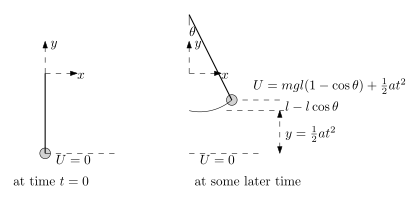
The coordinate system is as shown below. \(U=0\) is taken when the pendulum is hanging in the vertical
position before the base starts moving upwards.
Therefore,
\[ U=mgl\left ( 1-\cos \theta \right ) +\frac {1}{2}at^{2}\]
Where \(y=\frac {1}{2}at^{2}\) is the distance the pendulum moves upwards in time \(t\) since it has constant
acceleration. We now need to obtain the kinetic energy. Resolving the velocity of the pendulum
bob in the horizontal and in the vertical direction gives
\begin{align*} \dot {x} & =l\dot {\theta }\cos \theta \\ \dot {y} & =l\dot {\theta }\sin \theta +at \end{align*}
Therefore
\begin{align*} v^{2} & =\dot {x}^{2}+\dot {y}^{2}\\ & =\left ( l\dot {\theta }\right ) ^{2}\cos ^{2}\theta +\left ( l\dot {\theta }\right ) ^{2}\sin ^{2}\theta +a^{2}t^{2}+2atl\dot {\theta }\sin \theta \\ & =l^{2}\dot {\theta }^{2}+a^{2}t^{2}+2atl\dot {\theta }\sin \theta \end{align*}
Hence
\begin{align*} T & =\frac {1}{2}mv^{2}\\ & =\frac {1}{2}m\left ( l^{2}\dot {\theta }^{2}+a^{2}t^{2}+2atl\dot {\theta }\sin \theta \right ) \end{align*}
Now that \(U\) and \(T\) are determined, the Lagrangian \(L\) is computed
\begin{align*} \,L & =T-U\\ & =\frac {1}{2}m\left ( l^{2}\dot {\theta }^{2}+a^{2}t^{2}+2atl\dot {\theta }\sin \theta \right ) -mgl\left ( 1-\cos \theta \right ) +\frac {1}{2}at^{2}\end{align*}
Hence
\[ \frac {\partial L}{\partial \theta }=matl\dot {\theta }\cos \theta -mgl\sin \theta \]
And
\[ \frac {\partial L}{\partial \dot {\theta }}=ml^{2}\dot {\theta }+matl\sin \theta \]
Hence
\[ \frac {d}{dt}\frac {\partial L}{\partial \dot {\theta }}=ml^{2}\ddot {\theta }+mal\sin \theta +\dot {\theta }matl\cos \theta \]
Therefore the Euler Lagrangian equation is
\begin{align*} \frac {\partial L}{\partial \theta }-\frac {d}{dt}\frac {\partial L}{\partial \dot {\theta }} & =0\\ matl\dot {\theta }\cos \theta -mgl\sin \theta -\left ( ml^{2}\ddot {\theta }+mal\sin \theta +\dot {\theta }matl\cos \theta \right ) & =0\\ -mgl\sin \theta -ml^{2}\ddot {\theta }-mal\sin \theta & =0 \end{align*}
Hence
\[ \fbox {$\ddot {\theta }+\frac {g}{l}\sin \theta +\frac {a}{l}\sin \theta =0$}\]
For small oscillations \(\sin \theta \approx \theta \) and the above becomes
\[ \ddot {\theta }+\theta \left ( \frac {g+a}{l}\right ) =0 \]
Which is now in the form \(\ddot {\theta }+\omega _{n}^{2}\theta =0\) where \(\omega _{n}=\frac {2\pi }{T}\) is the
undamped natural radian frequency, and \(T\) is the period of oscillation in seconds. hence
\begin{align*} T & =\frac {2\pi }{\omega _{n}}\\ & =\frac {2\pi }{\sqrt {\left ( \frac {g+a}{l}\right ) }}\\ & =2\pi \sqrt {\left ( \frac {l}{g+a}\right ) }\end{align*}
4.2.4 Problem 4
SOLUTION
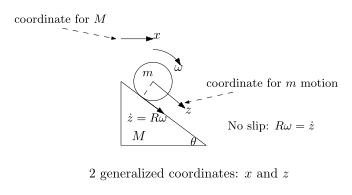
There are 2 generalized coordinates in this problem. One for the motion of center of mass of \(m\) and
one for the motion of the wedge \(M\) itself. The positive directions are taken as shown in this
diagram
The first step is to determine the kinetic energy \(T\) and potential energy \(U\) of the whole system. For
mass \(M\)
\[ T_{M}=\frac {1}{2}M\dot {x}^{2}\]
For the rolling mass \(m\) since it has both rotational motion and translation motion then
\begin{equation} T_{m}=\frac {1}{2}m\left [ \left ( \dot {x}+\dot {z}\cos \theta \right ) ^{2}+\left ( \dot {z}\sin \theta \right ) ^{2}\right ] +\frac {1}{2}I\omega ^{2} \tag {1}\end{equation}
Where
in the above the term \(\left ( \dot {x}+\dot {z}\cos \theta \right ) ^{2}+\left ( \dot {z}\sin \theta \right ) ^{2}\) is the translation velocity of the rolling mass. Since the motion is without
slip, then we can now relate \(\omega \) to \(z\) using
\[ R\omega =\dot {z}\]
Hence (1) becomes
\[ T_{m}=\frac {1}{2}m\left [ \left ( \dot {x}+\dot {z}\cos \theta \right ) ^{2}+\left ( \dot {z}\sin \theta \right ) ^{2}\right ] +\frac {1}{2}I\left ( \frac {\dot {z}}{R}\right ) ^{2}\]
But \(I=\frac {2}{5}R^{2}m\), hence the above reduces to
\[ T_{m}=\frac {1}{2}m\left [ \left ( \dot {x}+\dot {z}\cos \theta \right ) ^{2}+\left ( \dot {z}\sin \theta \right ) ^{2}\right ] +\frac {1}{5}m\dot {z}^{2}\]
Now
that the overall \(T\) is found from
\begin{align*} T & =T_{M}+T_{m}\\ & =\frac {1}{2}M\dot {x}^{2}+\frac {1}{2}m\left [ \left ( \dot {x}+\dot {z}\cos \theta \right ) ^{2}+\left ( \dot {z}\sin \theta \right ) ^{2}\right ] +\frac {1}{5}m\dot {z}^{2}\\ & =\frac {1}{2}M\dot {x}^{2}+\frac {1}{2}m\left [ \dot {x}^{2}+\dot {z}^{2}\cos ^{2}\theta +2\dot {x}\dot {z}\cos \theta +\dot {z}^{2}\sin ^{2}\theta \right ] +\frac {1}{5}m\dot {z}^{2}\\ & =\frac {1}{2}M\dot {x}^{2}+\frac {1}{2}m\left ( \dot {x}^{2}+\dot {z}^{2}+2\dot {x}\dot {z}\cos \theta \right ) +\frac {1}{5}m\dot {z}^{2}\\ & =\frac {1}{2}M\dot {x}^{2}+\frac {1}{2}m\dot {x}^{2}+m\dot {x}\dot {z}\cos \theta +\frac {7}{10}m\dot {z}^{2}\end{align*}
Now we find \(U\). The potential energy comes from the rolling mass losing \(U\) as it moves down.
Assuming zero \(U\) is at top of the wedge, the distance it moves it \(z\sin \theta \,\). Hence
\[ U=-mgz\sin \theta \]
Now the Lagrangian is
found \(L=T-U\), hence
\[ \fbox {$L=\left ( \frac {1}{2}M\dot {x}^2+\frac {1}{2}m\dot {x}^2+m\dot {x}\dot {z}\cos \theta +\frac {7}{10}m\dot {z}^2\right ) +mgz\sin \theta $}\]
Let us find the equation of motion for \(m\), which has acceleration \(\ddot {z}\) first, then find the
equation of motion for \(M\) which is the required acceleration \(\ddot {x}\)
\begin{align*} \frac {\partial L}{\partial z} & =mg\cos \theta \\ \frac {\partial L}{\partial \dot {z}} & =m\dot {x}\cos \theta +\frac {7}{5}m\dot {z}\\ \frac {d}{dt}\frac {\partial L}{\partial \dot {z}} & =m\ddot {x}\cos \theta +\frac {7}{5}m\ddot {z}\end{align*}
Therefore, using Euler-Lagrangian equation
\begin{align*} \frac {d}{dt}\frac {\partial L}{\partial \dot {z}}-\frac {\partial L}{\partial z} & =0\\ m\ddot {x}\cos \theta +\frac {7}{5}m\ddot {z}-mg\cos \theta & =0 \end{align*}
Hence
\begin{equation} \fbox {$\ddot {z}=\frac {5}{7}\left ( g\sin \theta -\ddot {x}\cos \theta \right ) $} \tag {2}\end{equation}
We now apply Euler-Lagrangian equation to find \(\ddot {x}\,\ \)
\begin{align*} \frac {\partial L}{\partial x} & =0\\ \frac {\partial L}{\partial \dot {x}} & =M\dot {x}+m\dot {x}+m\dot {z}\cos \theta \\ \frac {d}{dt}\frac {\partial L}{\partial \dot {x}} & =M\ddot {x}+m\ddot {x}+m\ddot {z}\cos \theta \end{align*}
Therefore
\begin{align*} \frac {d}{dt}\frac {\partial L}{\partial \dot {x}}-\frac {\partial L}{\partial x} & =0\\ M\ddot {x}+m\ddot {x}+m\ddot {z}\cos \theta & =0\\ \ddot {x}\left ( M+m\right ) & =-m\ddot {z}\cos \theta \end{align*}
But we found \(\ddot {z}\) earlier. Hence using (2) into the above gives
\begin{align*} \ddot {x}\left ( M+m\right ) & =-m\frac {5}{7}\left ( g\sin \theta -\ddot {x}\cos \theta \right ) \cos \theta \\ \ddot {x}\left ( M+m\right ) & =\frac {5}{7}m\ddot {x}\cos ^{2}\theta -\frac {5}{7}mg\sin \theta \cos \theta \\ \ddot {x}\left ( M+m\right ) -\frac {5}{7}m\ddot {x}\cos ^{2}\theta & =-m\frac {5}{7}g\sin \theta \cos \theta \\ \ddot {x}\left ( \left ( M+m\right ) -\frac {5}{7}m\cos ^{2}\theta \right ) & =-\frac {5}{7}mg\sin \theta \cos \theta \\ \ddot {x} & =\frac {-\frac {5}{7}mg\sin \theta \cos \theta }{\left ( \left ( M+m\right ) -\frac {5}{7}m\cos ^{2}\theta \right ) }\\ & =\frac {-5mg\sin \theta \cos \theta }{7\left ( M+m\right ) -5m\cos ^{2}\theta }\end{align*}
Hence
\[ \fbox {$\ddot {x}=\frac {5g\sin \theta \cos \theta }{5\cos ^2\theta -7\left ( \frac {M+m}{m}\right ) }$}\]
4.2.5 Problem 5
SOLUTION
In a central force field, the force on the particle depends only on the magnitude of the direct
distance \(r\) between the particle and the center of the force. Let the force be located at the origin,
then the force on the particle depends only on the magnitude of the position vector \(\mathbf {r}\) of the particle
and not on the angular position of the particle.
\[ \mathbf {F}=F\left ( r\right ) \mathbf {\hat {r}}\]
Where \(\mathbf {\hat {r}}\) is a unit vector pointing in the direction of
the force. If the force \(\mathbf {F}\) causes the distance \(r\) between the particle and the origin (where the source of
force is assumed) to become smaller, then this force is attractive and it is assigned a negative sign.
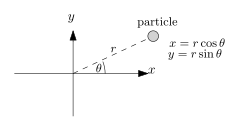
There are 2 degrees of freedom, hence there are two generalized coordinates. It is easier to use
polar coordinates \(\left ( r,\theta \right ) \) where \(r\) is the distance of the particle from the origin, and \(\theta \) is the angle from the \(x\)
axis
The kinetic energy is
\[ T=\frac {1}{2}m\left ( \dot {x}^{2}+\dot {y}^{2}\right ) \]
But \(x=r\cos \theta \), hence \(\dot {x}=\dot {r}\cos \theta -r\dot {\theta }\sin \theta \) and \(y=r\sin \theta \), hence \(\dot {y}=\dot {r}\sin \theta +r\dot {\theta }\cos \theta \), therefore
\begin{align*} \dot {x}^{2}+\dot {y}^{2} & =\left ( \dot {r}\cos \theta -r\dot {\theta }\sin \theta \right ) ^{2}+\left ( \dot {r}\sin \theta +r\dot {\theta }\cos \theta \right ) ^{2}\\ & =\left ( \dot {r}^{2}\cos ^{2}\theta +r^{2}\dot {\theta }^{2}\sin ^{2}\theta -2r\dot {r}\dot {\theta }\cos \theta \sin \theta \right ) +\left ( \dot {r}^{2}\sin ^{2}\theta +r^{2}\dot {\theta }^{2}\cos ^{2}\theta +2r\dot {r}\dot {\theta }\sin \theta \cos \theta \right ) \\ & =\dot {r}^{2}\cos ^{2}\theta +r^{2}\dot {\theta }^{2}\sin ^{2}\theta +\dot {r}^{2}\sin ^{2}\theta +r^{2}\dot {\theta }^{2}\cos ^{2}\theta \\ & =\dot {r}^{2}+r^{2}\dot {\theta }^{2}\end{align*}
Hence in polar coordinates
\[ T=\frac {1}{2}m\left ( \dot {r}^{2}+r^{2}\dot {\theta }^{2}\right ) \]
And
\[ U\left ( r\right ) =V\left ( r\right ) \]
Therefore the Lagrangian
\begin{align*} L & =T-V\\ & =\frac {1}{2}m\left ( \dot {r}^{2}+r^{2}\dot {\theta }^{2}\right ) -V\left ( r\right ) \end{align*}
Therefore
\begin{align*} \frac {\partial L}{\partial r} & =mr\dot {\theta }^{2}-\frac {\partial V\left ( r\right ) }{\partial r}\\ \frac {\partial L}{\partial \dot {r}} & =m\dot {r}\\ \frac {d}{dt}\frac {\partial L}{\partial \dot {r}} & =m\ddot {r}\end{align*}
Hence the equation of motion for the linear (radial) coordinate \(r\) is
\begin{align*} \left ( mr\dot {\theta }^{2}-\frac {\partial V\left ( r\right ) }{\partial r}\right ) -m\ddot {r} & =0\\ m\ddot {r} & =mr\dot {\theta }^{2}-\frac {\partial V\left ( r\right ) }{\partial r}\end{align*}
But \(-\frac {\partial V\left ( r\right ) }{\partial r}=f\left ( r\right ) \) then
\begin{equation} \fbox {$m\ddot {r}=mr\dot {\theta }^2+f\left ( r\right ) $} \tag {1}\end{equation}
Now the equation of motion in the \(\theta \) coordinate is found.
\begin{align*} \frac {\partial L}{\partial \theta } & =0\\ \frac {\partial L}{\partial \dot {\theta }} & =mr^{2}\dot {\theta }\\ \frac {d}{dt}\frac {\partial L}{\partial \dot {\theta }} & =\frac {d}{dt}\left ( mr^{2}\dot {\theta }\right ) \end{align*}
Hence, since \(\frac {\partial L}{\partial \theta }=0\) then \(\frac {d}{dt}\left ( mr^{2}\dot {\theta }\right ) =0\) or
\begin{equation} \fbox {$mr^2\dot {\theta }=$constant} \tag {2}\end{equation}
Therefore (2) shows that the angular momentum \(I\omega \) is conserved (where \(I\) is \(mr^{2}\),
the moment of inertia). This is called the integral of motion.
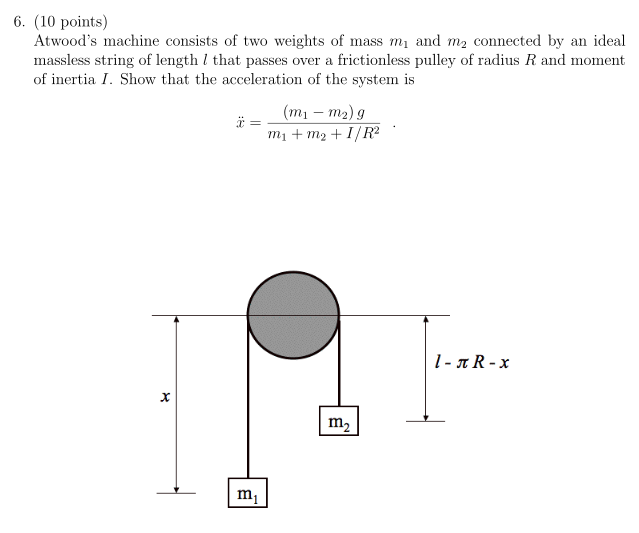
4.2.6 Problem 6
SOLUTION
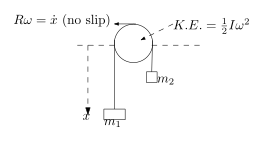
Since both masses will move with same speed \(\dot {x}\), then the total kinetic energy of the system is
\[ T=\frac {1}{2}m_{1}\dot {x}^{2}+\frac {1}{2}m_{2}\dot {x}^{2}+\frac {1}{2}I\omega ^{2}\]
Assuming no slip, we can relate \(\omega \) to \(\dot {x}\) using \(R\omega =\dot {x}\), hence the above becomes
\begin{align*} T & =\frac {1}{2}m_{1}\dot {x}^{2}+\frac {1}{2}m_{2}\dot {x}^{2}+\frac {1}{2}I\left ( \frac {\dot {x}}{R}\right ) ^{2}\\ & =\frac {1}{2}\dot {x}^{2}\left ( m_{1}+m_{2}+\frac {I}{R^{2}}\right ) \end{align*}
Using \(U=0\) as the level shown where the pulley is located, then
\[ V=-m_{1}xg-m_{2}\left ( l-\pi R-x\right ) g \]
Hence the Lagrangian \(L\) is
\begin{align*} L & =T-V\\ & =\frac {1}{2}\dot {x}^{2}\left ( m_{1}+m_{2}+\frac {I}{R^{2}}\right ) -\left ( -m_{1}x-m_{2}\left ( l-\pi R-x\right ) \right ) g\\ & =\frac {1}{2}\dot {x}^{2}\left ( m_{1}+m_{2}+\frac {I}{R^{2}}\right ) +\left ( m_{1}x+m_{2}l-m_{2}\pi R-xm_{2}\right ) g \end{align*}
Hence
\[ \frac {\partial L}{\partial x}=\left ( m_{1}-m_{2}\right ) g \]
And
\begin{align*} \frac {\partial L}{\partial \dot {x}} & =\dot {x}\left ( m_{1}+m_{2}+\frac {I}{R^{2}}\right ) \\ \frac {d}{dt}\frac {\partial L}{\partial \dot {x}} & =\ddot {x}\left ( m_{1}+m_{2}+\frac {I}{R^{2}}\right ) \end{align*}
Therefore
\begin{align*} \frac {d}{dt}\frac {\partial L}{\partial \dot {x}}-\frac {\partial L}{\partial x} & =0\\ \ddot {x}\left ( m_{1}+m_{2}+\frac {I}{R^{2}}\right ) -\left ( m_{1}-m_{2}\right ) g & =0 \end{align*}
Therefore
\[ \fbox {$\ddot {x}=\frac {\left ( m_1-m_2\right ) g}{m_1+m_2+\frac {I}{R^2}}$}\]
4.2.7 HW 2 key solution