4.3 HW 3
This HW in one PDF
4.3.1 Problem 1
SOLUTION
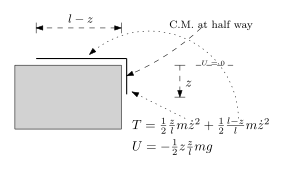
The top portion of the rope moves with same speed as the hanging portion. Hence \(z\) is used to
describe the motion as the generalized coordinate. From the above
\begin{align*} U & =-\left ( \frac {1}{2}z\right ) \left ( \frac {z}{l}\right ) mg=-\frac {1}{2}\left ( \frac {z^{2}}{l}\right ) mg\\ T & =\frac {1}{2}\left ( \frac {z}{l}\right ) m\dot {z}^{2}+\frac {1}{2}\left ( \frac {l-z}{l}\right ) m\dot {z}^{2}=\frac {1}{2}m\dot {z}^{2}\end{align*}
In finding \(U\) we used \(\frac {1}{2}\) since the center of mass of the hanging part is half way over the length. So the
potential energy is taken from the center of mass. In the above, \(\dot {z}\) is used for both parts
of the rope, since both parts move with same speed. Applying Lagrangian equations
gives
\begin{align*} L & =T-U\\ & =\frac {1}{2}m\dot {z}^{2}+\frac {1}{2}\left ( \frac {z^{2}}{l}\right ) mg \end{align*}
Hence
\begin{align*} \frac {\partial L}{\partial z} & =\frac {z}{l}mg\\ \frac {d}{dt}\frac {\partial L}{\partial \dot {z}} & =m\ddot {z}\end{align*}
And therefore
\begin{align*} \frac {d}{dt}\frac {\partial L}{\partial \dot {z}}-\frac {\partial L}{\partial z} & =0\\ m\ddot {z}-\frac {z}{l}mg & =0\\ \ddot {z} & =\frac {z}{l}g \end{align*}
When \(z=0\) then the acceleration is zero as expected. When \(z=\frac {l}{2}\) then \(\ddot {z}=\frac {1}{2}g\) and when \(z=l\) then \(\ddot {z}=g\) as expected since in
this case the rope will all be falling down on its own weight due to gravity and should have \(g\) as the
acceleration.
4.3.2 Problem 2
SOLUTION
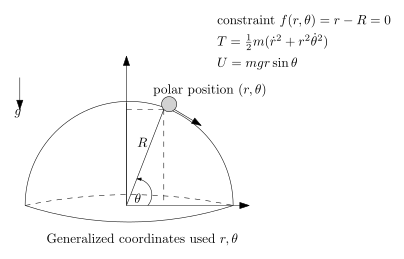
There are two coordinates \(r,\theta \) (polar) and one constraint
\begin{equation} f\left ( r,\theta \right ) =r-R=0 \tag {1}\end{equation}
Now we set up the equations of motion for
\(m\)
\begin{align*} T & =\frac {1}{2}m\left ( \dot {r}^{2}+r^{2}\dot {\theta }^{2}\right ) \\ U & =mgr\sin \theta \\ L & =T-U\\ & =\frac {1}{2}m\left ( \dot {r}^{2}+r^{2}\dot {\theta }^{2}\right ) -mgr\sin \theta \end{align*}
Hence the Euler-Lagrangian equations are
\begin{align} \frac {d}{dt}\frac {\partial L}{\partial \dot {r}}-\frac {\partial L}{\partial r}+\lambda \frac {\partial f}{\partial r} & =0\tag {2}\\ \frac {d}{dt}\frac {\partial L}{\partial \dot {\theta }}-\frac {\partial L}{\partial \theta }+\lambda \frac {\partial f}{\partial \theta } & =0 \tag {3}\end{align}
But
\begin{align*} \frac {d}{dt}\frac {\partial L}{\partial \dot {r}} & =m\ddot {r}\\ \frac {\partial L}{\partial \dot {\theta }} & =mr^{2}\dot {\theta }\\ \frac {d}{dt}\left ( \frac {\partial L}{\partial \dot {\theta }}\right ) & =m\left ( 2r\dot {r}\dot {\theta }+r^{2}\ddot {\theta }\right ) \\ \frac {\partial L}{\partial r} & =mr\dot {\theta }^{2}-mg\sin \theta \\ \frac {\partial L}{\partial \theta } & =-mgr\cos \theta \\ \frac {\partial f}{\partial r} & =1\\ \frac {\partial f}{\partial \theta } & =0 \end{align*}
Hence (2) becomes
\begin{equation} m\ddot {r}-mr\dot {\theta }^{2}+mg\sin \theta +\lambda =0 \tag {4}\end{equation}
And (3) becomes
\begin{align} m\left ( 2r\dot {r}\dot {\theta }+r^{2}\ddot {\theta }\right ) +mgr\cos \theta & =0\nonumber \\ r\ddot {\theta }+2\dot {r}\dot {\theta }+g\cos \theta & =0 \tag {5}\end{align}
We now need to solve (1,4,5) for \(\lambda \). Now we have to apply the constrain that \(r=R\) in the above to be able
to solve (4,5) equations. Therefore, (4,5) becomes
\begin{align} -mR\dot {\theta }^{2}+mg\cos \theta +\lambda & =0\tag {4A}\\ R\ddot {\theta }+g\cos \theta & =0 \tag {5A}\end{align}
Where (4A,5A) were obtained from (4,5) by replacing \(r=R\) and \(\dot {r}=0\) and \(\ddot {r}=0\) since we are using that \(r=R\) which is
constant (the radius).
From (5A) we see that this can be integrated giving
\begin{equation} R\dot {\theta }^{2}+2g\sin \theta +c=0 \tag {6}\end{equation}
Where \(c\) is constant. Since if we differentiate
the above with time, we obtain
\begin{align*} 2R\dot {\theta }\ddot {\theta }+2g\dot {\theta }\cos \theta & =0\\ R\ddot {\theta }+g\cos \theta & =0 \end{align*}
Which is the same as (5A). Therefore from (6) we find \(\dot {\theta }^{2}\) to use in (4A). Hence from (6)
\[ \dot {\theta }^{2}=-2\frac {g}{R}\sin \theta +c \]
To find \(c\) we
use initial conditions. At \(t=0\), \(\theta =90^{0}\) and \(\dot {\theta }\left ( 0\right ) =0\) hence
\[ c=2\frac {g}{R}\]
Therefore
\begin{align*} \dot {\theta }^{2} & =-2\frac {g}{R}\sin \theta +2\frac {g}{R}\\ & =2\frac {g}{R}\left ( 1-\sin \theta \right ) \end{align*}
Plugging the above into (4A) in order to find \(\lambda \) gives
\begin{align*} -mR\left ( 2\frac {g}{R}\left ( 1-\sin \theta \right ) \right ) +mg\sin \theta +\lambda & =0\\ \lambda & =m\left ( 2g\left ( 1-\sin \theta \right ) \right ) -mg\sin \theta \\ \lambda & =2mg-2mg\sin \theta -mg\sin \theta \\ & =mg\left ( 2-3\sin \theta \right ) \end{align*}
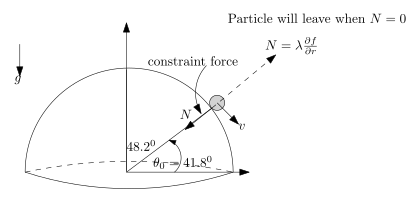
Now that we found \(\lambda \,,\)we can find the constraint force in the radial direction
\begin{align*} N & =\lambda \frac {\partial f}{\partial r}\\ & =mg\left ( 2-3\sin \theta \right ) \end{align*}
The particle will leave when \(N=0\) which will happen when
\begin{align*} 2-3\sin \theta & =0\\ \theta & =\sin ^{-1}\left ( \frac {2}{3}\right ) \\ & =41.8^{0}\end{align*}
Therefore, the angle from the vertical is
\[ 90-41.8=48.2^{0}\]
4.3.3 Problem 3
SOLUTION
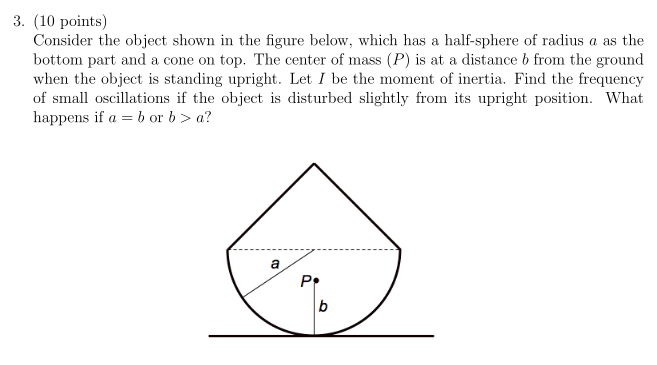
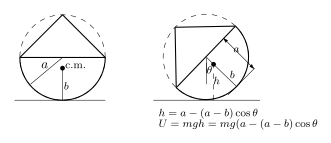
From the above, we see that the center of mass has height above the ground level after rotation of
\[ h=a-\left ( a-b\right ) \cos \theta \]
Taking the ground state as the floor, the potential energy in this state is
\begin{align*} U & =mgh\\ & =mg\left ( a-\left ( a-b\right ) \cos \theta \right ) \end{align*}
And the kinetic energy
\[ T=\frac {1}{2}I\dot {\theta }^{2}\]
Hence the Lagrangian is
\begin{align*} L & =T-U\\ & =\frac {1}{2}I\dot {\theta }^{2}-mg\left ( a-\left ( a-b\right ) \cos \theta \right ) \end{align*}
Therefore the equation of motion is
\begin{align*} \frac {d}{dt}\frac {\partial L}{\partial \dot {\theta }}-\frac {\partial L}{\partial \theta } & =0\\ I\ddot {\theta }-\frac {\partial }{\partial \theta }\left ( \frac {1}{2}I\dot {\theta }^{2}-mg\left ( a-\left ( a-b\right ) \cos \theta \right ) \right ) & =0\\ I\ddot {\theta }+\frac {\partial }{\partial \theta }mg\left ( a-\left ( a-b\right ) \cos \theta \right ) & =0\\ I\ddot {\theta }-\frac {\partial }{\partial \theta }mg\left ( a-b\right ) \cos \theta & =0\\ I\ddot {\theta }+mg\left ( a-b\right ) \sin \theta & =0 \end{align*}
For small \(\theta ,\sin \theta \simeq \theta \), hence the above becomes
\[ \ddot {\theta }+\frac {mg\left ( a-b\right ) }{I}\theta =0 \]
Therefore the natural angular frequency is
\[ \fbox {$\omega _n=\sqrt {\frac {mg\left ( a-b\right ) }{I}}$}\]
When \(a=b\) then \(\omega _{n}=0\) and
the mass do not oscillate but remain at the new positions. When \(b>a\) then \(\omega _{n}\) is complex valued. This is
not possible, as the natural frequency must be real. So center of mass can not be in the upper
half.
4.3.4 Problem 4
SOLUTION
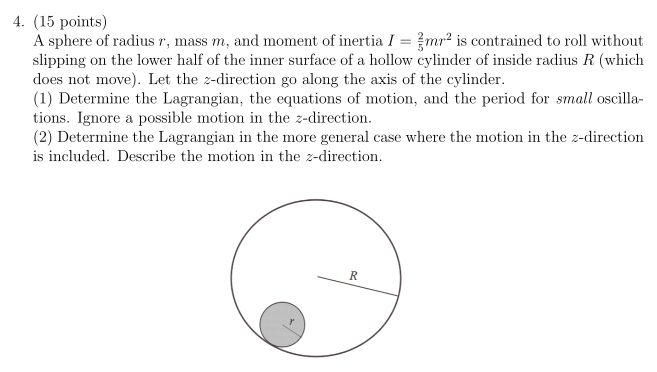
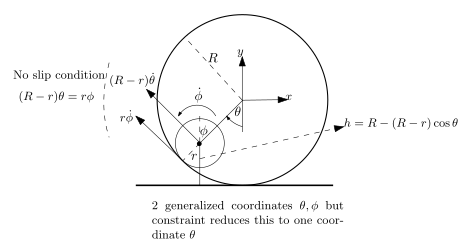
Part (1): There are two coordinates are \(\theta ,\phi ,\) but due to dependency between them (no slip) then this
reduces the degree of freedom by one, and there is one generalized coordinate \(\theta \). The constraints of
no slip means
\[ f\left ( \theta ,\phi \right ) =\left ( R-r\right ) \theta -r\phi =0 \]
Which means the center of the small disk move in speed the same as the
point of the disk that moves on the edge of the larger cylinder as shown in the figure
above.
\begin{align*} T & =\frac {1}{2}I\dot {\phi }^{2}+\frac {1}{2}m\left ( \left ( R-r\right ) \dot {\theta }\right ) ^{2}\\ U & =mgh=mg\left ( R-\left ( R-r\right ) \cos \theta \right ) \end{align*}
Using \(I=\frac {2}{5}mr^{2}\) and using \(\dot {\phi }=\frac {\left ( R-r\right ) }{r}\dot {\theta }\) from the constraint conditions, then \(T\) becomes
\begin{align*} T & =\frac {1}{2}\left ( \frac {2}{5}mr^{2}\right ) \left ( \frac {\left ( R-r\right ) }{r}\dot {\theta }\right ) ^{2}+\frac {1}{2}m\left ( \left ( R-r\right ) \dot {\theta }\right ) ^{2}\\ & =\frac {1}{5}m\left ( R-r\right ) ^{2}\dot {\theta }^{2}+\frac {1}{2}m\left ( R-r\right ) ^{2}\dot {\theta }^{2}\\ & =\frac {7}{10}m\left ( R-r\right ) ^{2}\dot {\theta }^{2}\end{align*}
Hence
\begin{align*} L & =T-U\\ & =\frac {7}{10}m\left ( R-r\right ) ^{2}\dot {\theta }^{2}-mg\left ( R-\left ( R-r\right ) \cos \theta \right ) \end{align*}
And
\begin{align*} \frac {\partial L}{\partial \theta } & =-mg\left ( R-r\right ) \sin \theta \\ \frac {\partial L}{\partial \dot {\theta }} & =\frac {7}{5}m\left ( R-r\right ) ^{2}\dot {\theta }\end{align*}
Therefore the equation of motion is
\begin{align*} \frac {d}{dt}\frac {\partial L}{\partial \dot {\theta }}-\frac {\partial L}{\partial \theta } & =0\\ \frac {7}{5}m\left ( R-r\right ) ^{2}\ddot {\theta }+mg\left ( R-r\right ) \sin \theta & =0\\ \ddot {\theta }+\frac {g}{\frac {7}{5}\left ( R-r\right ) }\sin \theta & =0 \end{align*}
For small angle
\[ \ddot {\theta }+\frac {5g}{7\left ( R-r\right ) }\theta =0 \]
The frequency of oscillation is
\[ \omega _{n}=\sqrt {\frac {5g}{7\left ( R-r\right ) }}\]
Using \(\omega _{n}=\frac {2\pi }{T}\) then the period of oscillation
is
\[ T=\frac {2\pi }{\sqrt {\frac {5g}{7\left ( R-r\right ) }}}=2\pi \sqrt {\frac {7\left ( R-r\right ) }{5g}}\]
Part (2):
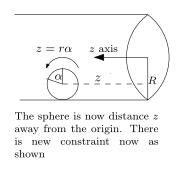
There are now two generalized coordinates, \(\theta \) and \(z.\) The sphere now rotates in 2 angular motions, \(\dot {\phi }\)
which is the same as it did in part 1, and in addition, it rotate with angular motion, \(\dot {\alpha }\) which is
rolling down the \(z\) axis. The new constraint is that
\begin{equation} f_{1}\left ( \alpha ,z\right ) =z-r\alpha =0\tag {1}\end{equation}
So that no slip occurs in the \(z\) direction. This is
in additional of the original no slip condition which is
\begin{equation} f_{2}\left ( \theta ,\phi \right ) =\left ( R-r\right ) \theta -r\phi =0\tag {2}\end{equation}
The following diagram illustrates
this
Now there are translation kinetic energy in the \(z\) direction as well as new rotational kinetic energy
due to spin \(\alpha \). Therefore
\begin{align*} T & =\overset {\text {part(1)}}{\overbrace {\frac {1}{2}I\dot {\phi }^{2}+\frac {1}{2}m\left ( \left ( R-r\right ) \dot {\theta }\right ) ^{2}}}+\overset {\text {due to moving in z}}{\overbrace {\frac {1}{2}m\dot {z}^{2}+\frac {1}{2}I\dot {\alpha }^{2}}}\\ U & =mgh=mg\left ( R-\left ( R-r\right ) \cos \theta \right ) \end{align*}
Notice that the potential energy do not change, since it depends only on the height above the
ground. Using \(I=\frac {2}{5}mr^{2}\) and from constraints (1,2) then \(T\) becomes
\begin{align*} T & =\frac {1}{2}\left ( \frac {2}{5}mr^{2}\right ) \overset {\dot {\phi }^{2}}{\overbrace {\left ( \frac {\left ( R-r\right ) }{r}\dot {\theta }\right ) ^{2}}}+\frac {1}{2}m\left ( \left ( R-r\right ) \dot {\theta }\right ) ^{2}+\frac {1}{2}m\dot {z}^{2}+\frac {1}{2}\left ( \frac {2}{5}mr^{2}\right ) \overset {\dot {\alpha }^{2}}{\overbrace {\left ( \frac {\dot {z}}{r}\right ) ^{2}}}\\ & =\left ( \frac {1}{5}mr^{2}\right ) \frac {\left ( R-r\right ) }{r^{2}}\dot {\theta }^{2}+\frac {1}{2}m\left ( R-r\right ) ^{2}\dot {\theta }^{2}+\frac {1}{2}m\dot {z}^{2}+\left ( \frac {1}{5}mr^{2}\right ) \frac {\dot {z}^{2}}{r^{2}}\\ & =\frac {7}{10}m\left ( R-r\right ) \dot {\theta }^{2}+\frac {7}{10}m\dot {z}^{2}\end{align*}
Hence the Lagrangian is
\begin{align*} L & =T-U\\ & =\frac {7}{10}m\left ( R-r\right ) \dot {\theta }^{2}+\frac {7}{10}m\dot {z}^{2}-mg\left ( R-\left ( R-r\right ) \cos \theta \right ) \end{align*}
This part only now asks for motion in \(z\) direction. Hence
\begin{align*} \frac {\partial L}{\partial z} & =0\\ \frac {\partial L}{\partial \dot {z}} & =\frac {7}{5}m\dot {z}\end{align*}
Since \(\frac {\partial L}{\partial z}=0\) then
\[ \frac {d}{dt}\frac {\partial L}{\partial \dot {z}}=0 \]
Hence \(\frac {\partial L}{\partial \dot {z}}\) is the integral of motion. Or
\[ \frac {7}{5}m\ddot {z}=0 \]
or
\begin{align*} \ddot {z} & =0\\ \dot {z} & =c \end{align*}
Where \(c\) is constant. This means the sphere rolls down the \(z\) axis at constant speed.
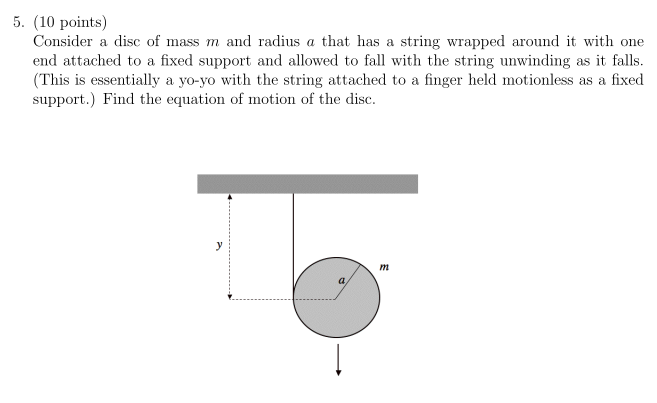
4.3.5 Problem 5
SOLUTION
This is first solved using energy method, then solved using Newton method.
Energy method
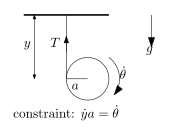
Constraint is \(f\left ( y,\theta \right ) =y-a\theta =0\). Hence \(\dot {\theta }=\frac {\dot {y}}{a}\)
\begin{align*} U & =-mgy\\ T & =\frac {1}{2}I\dot {\theta }^{2}+\frac {1}{2}m\dot {y}^{2}\\ & =\frac {1}{2}I\left ( \frac {\dot {y}}{a}\right ) ^{2}+\frac {1}{2}m\dot {y}^{2}\\ & =\frac {1}{2}\left ( \frac {1}{2}ma^{2}\right ) \left ( \frac {\dot {y}}{a}\right ) ^{2}+\frac {1}{2}m\dot {y}^{2}\\ & =\frac {1}{4}m\dot {y}^{2}+\frac {1}{2}m\dot {y}^{2}\\ & =\frac {3}{4}m\dot {y}^{2}\end{align*}
Hence
\begin{align*} L & =T-U\\ & =\frac {3}{4}m\dot {y}^{2}+mgy \end{align*}
Therefore
\begin{align*} \frac {\partial L}{\partial y} & =mg\\ \frac {\partial L}{\partial \dot {y}} & =\frac {3}{2}m\dot {y}\\ \frac {d}{dt}\frac {\partial L}{\partial \dot {y}} & =\frac {3}{2}m\ddot {y}\end{align*}
And the equation of motion becomes
\begin{align*} \frac {d}{dt}\frac {\partial L}{\partial \dot {y}}-\frac {\partial L}{\partial y} & =0\\ \frac {3}{2}m\ddot {y}-mg & =0\\ \ddot {y} & =\frac {2}{3}g \end{align*}
Newton method
Using Newton method, this can be solved as follows. The linear equation of motion is (positive is
taken downwards)
\begin{align} F & =m\ddot {y}\nonumber \\ -T+mg & =m\ddot {y}\tag {1}\end{align}
And the angular equation of motion is given by
\begin{equation} Ta=I\ddot {\theta }\tag {2}\end{equation}
Due to constraint \(f\left ( y,\theta \right ) =y-a\theta =0\), then
\[ \frac {\ddot {y}}{a}=\ddot {\theta }\]
Using the above in (2)
gives
\begin{align} Ta & =I\frac {\ddot {y}}{a}\nonumber \\ T & =I\frac {\ddot {y}}{a^{2}}\tag {3}\end{align}
Replacing \(T\) in (1) with the \(T\) found in (3) results in
\begin{align*} m\ddot {y} & =-I\frac {\ddot {y}}{a^{2}}+mg\\ \ddot {y}\left ( m+\frac {I}{a^{2}}\right ) & =mg\\ \ddot {y} & =\frac {mg}{m+\frac {I}{a^{2}}}\end{align*}
But \(I=\frac {1}{2}ma^{2}\) then the above becomes
\begin{align*} \ddot {y} & =\frac {mg}{m+\frac {\frac {1}{2}ma^{2}}{a^{2}}}\\ & =\frac {g}{1+\frac {1}{2}}\\ & =\frac {2}{3}g \end{align*}
Which is the same (as would be expected) using the energy method
4.3.6 HW 3 key solution